If you are wondering how to toilet train a cat, the first thing to understand is that the phrase can mean two different things.
Some people mean teaching a kitten or adult cat to use a litter box. Others mean training a cat to use a human toilet instead of a litter tray.
These are very different approaches.
For everyday cat care, litter box training is the recommended option. Cats naturally prefer suitable places where they can dig, eliminate, and cover their waste. A clean, accessible litter box supports these behaviors and also helps owners monitor their cats' health.
Although some cats can learn to use a human toilet, many veterinarians and feline behavior professionals advise against making it their only elimination option. It can interfere with natural digging behavior, make changes in urine output harder to notice, and create accessibility problems as cats age.
This guide explains how to teach a cat to use a litter box, how to handle training problems, and why human toilet training is generally not the best long-term solution.
Table of Contents
Can You Toilet Train a Cat?
Why Human Toilet Training Is Not Recommended
What You Need Before Toilet Training a Cat
How to Toilet Train a Cat to Use a Litter Box: 7 Steps
How to Toilet Train a Kitten
How to Train an Adult Cat to Use a Litter Box
What to Do When a Cat Refuses the Litter Box
How to Keep the Litter Box Clean and Comfortable
Choosing the Right Cat Litter for Training
When to Contact a Veterinarian
Frequently Asked Questions
1. Can You Toilet Train a Cat?
Yes, cats can learn where to eliminate, and many kittens develop litter box habits quickly with a suitable environment.
However, "toilet training" can refer to two separate methods.
Litter Box Training
Litter box training teaches a cat to use a dedicated tray filled with suitable cat litter.
This is the normal approach for indoor cats.
The cat can enter the box, dig in the litter, urinate or defecate, and cover the waste. Owners can then remove the waste and check for changes in their pet's elimination habits.
Litter box training is suitable for:
Newly adopted kittens.
Adult cats moving into a new home.
Rescue cats learning indoor elimination habits.
Cats transitioning from outdoor elimination to an indoor litter box.
Cats that need help rebuilding consistent litter box habits.
Human Toilet Training
Human toilet training attempts to teach a cat to balance on a toilet seat and eliminate directly into the toilet bowl.
Some commercial training kits use removable trays with gradually increasing center openings.
Although this approach is possible for some cats, it is generally not recommended as a replacement for a normal litter box.
The rest of this guide focuses on the safer and more practical approach: teaching your cat to use a litter box consistently.

2. Why Human Toilet Training Is Not Recommended
Teaching a cat to use a human toilet may appear convenient because it seems to eliminate litter scooping and reduce the need for a litter box.
However, convenience for the owner does not necessarily mean a better environment for the cat.
There are several important reasons to keep a normal litter box.
2.1 Cats Need an Opportunity to Dig and Cover Their Waste
Digging and covering are natural parts of feline elimination behavior.
A litter box provides a loose substrate that allows cats to perform these behaviors.
A conventional toilet does not provide the same opportunity.
Removing access to a suitable digging and covering area may make some cats feel uncomfortable or stressed.
2.2 You May Miss Important Health Warning Signs
A litter box provides useful information about your cat's daily health.
You can observe:
How often your cat urinates.
The number and size of urine clumps.
Changes in urine appearance.
Stool consistency.
Unusual changes in elimination frequency.
If everything goes directly into the toilet, some of these changes become much harder to monitor.
For example, an increase in urine volume can be one sign that deserves veterinary attention. A sudden change in urination frequency may also indicate a medical problem.
2.3 Toilet Seats Can Be Difficult to Access
Cats need to jump onto the toilet and maintain their balance on a relatively narrow surface.
This may be especially difficult for:
Older cats.
Cats with arthritis.
Cats recovering from surgery.
Cats with mobility problems.
Cats with poor balance.
Very young kittens.
A conventional litter box can be placed at floor level, with a low entry point that makes it easier to access.
2.4 Training Can Become a Problem as Your Cat Ages
A cat that can jump onto a toilet when young may find it increasingly difficult later in life.
If the cat has learned to eliminate only on a toilet, an age-related mobility problem can suddenly become a litter training problem.
A floor-level litter box is generally easier to adapt to changing physical needs.
2.5 Travel and Veterinary Visits Become More Complicated
Cats may need to stay at a boarding facility, veterinary hospital, or temporary home.
Most of these environments provide standard litter boxes rather than human toilets adapted for cats.
A cat that depends exclusively on a human toilet may have difficulty adjusting to a different elimination setup.
2.6 Sharing a Toilet Creates Hygiene Concerns
A toilet is shared by household members and may also be used by guests.
Cat feces can contain infectious organisms, including Toxoplasma gondii in some circumstances.
A dedicated litter box allows waste to be removed and handled separately.
The Centers for Disease Control and Prevention recommends changing cat litter daily because Toxoplasma parasites need time after being shed in feces to become infectious.
Our recommendation: Keep a normal litter box available throughout your cat's life. Do not remove it simply because a cat has learned to use a toilet seat.
3. What You Need Before Toilet Training a Cat
Before starting litter box training, prepare an appropriate elimination area.
You do not need complicated training equipment. A suitable tray, an acceptable litter material, and a quiet location are more important.
3.1 A Suitable Litter Box
The box should be large enough for your cat to enter, turn around, dig, and squat comfortably.
A commonly used veterinary guideline is to choose a rectangular box approximately 1.5 times the cat's body length, measured from the nose to the base of the tail.
For kittens, use a tray with low sides so they can enter and leave easily.
For older cats or cats with mobility problems, a low-entry design may also be more suitable.
3.2 The Right Cat Litter
Cats can have individual preferences for litter texture and scent.
Many cats prefer a fine, sand-like, unscented litter, but the best choice depends on the individual animal.
Before buying a large quantity, observe whether your cat is comfortable with the product.
You can explore different material options in our complete guide to choosing cat litter.
3.3 A Quiet and Accessible Location
Place the litter box somewhere that is:
Quiet and relatively private.
Easy to access at all times.
Away from food and water bowls.
Away from loud appliances.
Not blocked by closed doors.
Not easily interrupted by children or other animals.
Avoid frequently moving the box while your cat is learning.
3.4 A Scoop and Cleaning Supplies
Prepare a litter scoop, waste bags, and a mild detergent for regular cleaning.
An enzymatic cleaner formulated for pet urine can also be helpful when accidents happen outside the box.
Avoid punishing your cat for accidents. A calm response and thorough cleaning are more effective than shouting or physical correction.
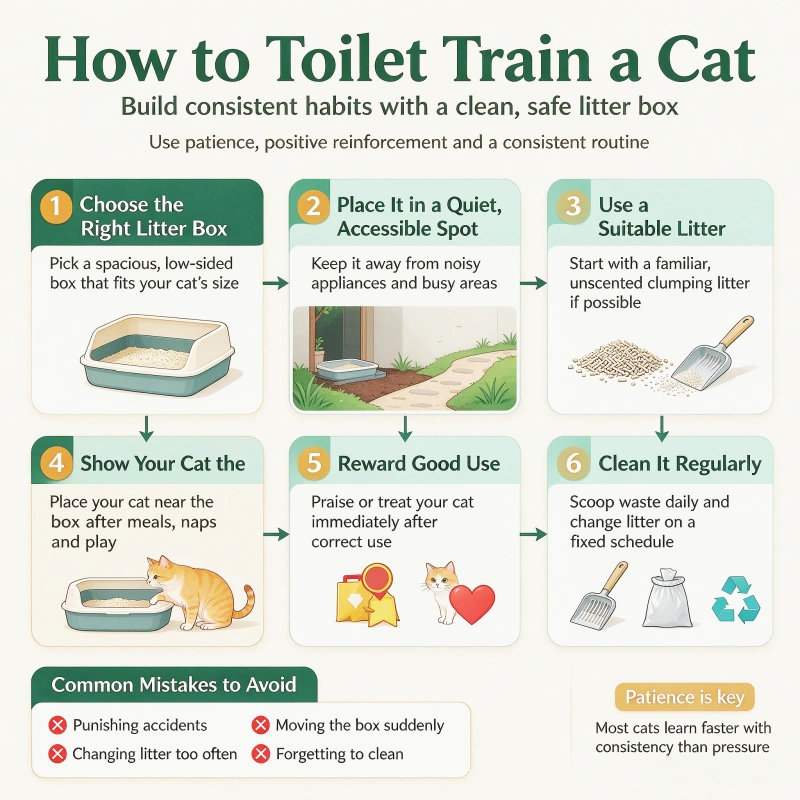
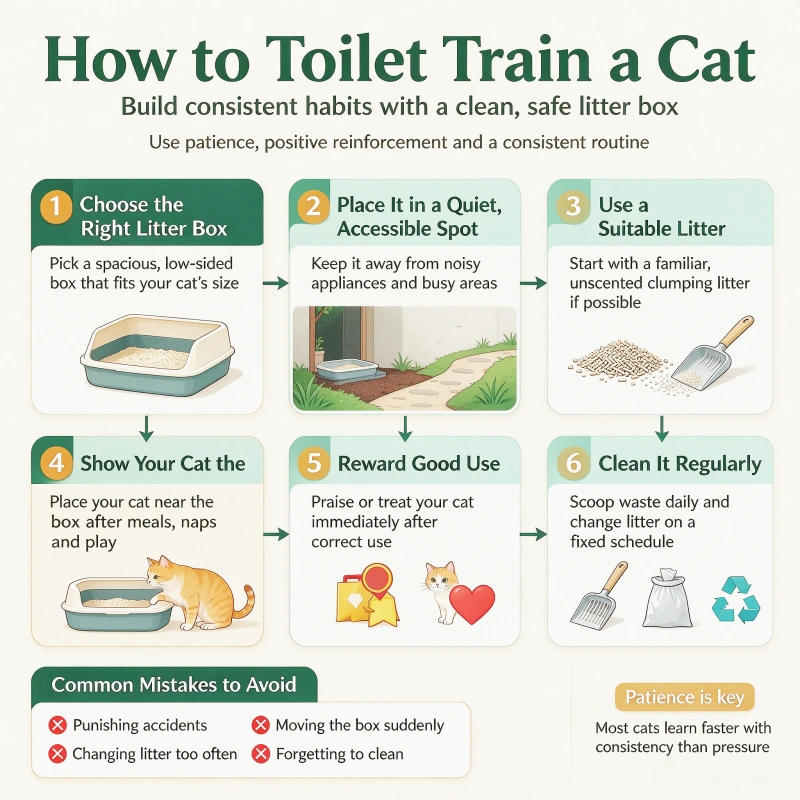
4. How to Toilet Train a Cat to Use a Litter Box: 7 Steps
Most cats can learn to use a suitable litter box with little formal training.
The goal is to make the box comfortable, accessible, and easy for your cat to recognize as an appropriate elimination area.
Step 1: Choose a Consistent Litter Box Location
Place the litter box in a quiet area where your cat can reach it easily.
Do not place it directly beside food or water bowls.
For multi-cat households, make sure that one cat cannot easily block another cat from reaching the tray.
Once you find a suitable location, avoid unnecessary changes while training is in progress.
Consistency helps cats become familiar with the elimination area.
Step 2: Select a Litter Box That Fits Your Cat
Choose a box that gives your cat enough space to enter, turn around, dig, and eliminate.
A box that is too small may cause discomfort or prevent normal posturing.
For young kittens, the entry should be low enough to step over.
For older cats, avoid designs that require climbing or jumping.
If your cat is newly adopted, ask the previous owner or shelter what kind of litter box and litter the cat was already using.
Keeping familiar features during the transition may make training easier.
Step 3: Introduce a Litter Your Cat Accepts
Fill the tray with an appropriate amount of litter so your cat can dig and cover waste.
Many cats prefer an unscented substrate with a soft texture.
Some cats dislike strongly scented litter or unusually large pellets.
If you want to change the litter type, introduce the new material gradually.
For example, you can offer a second litter box with the alternative litter and observe which one your cat chooses.
This gives the cat a choice instead of forcing an immediate change.
Step 4: Introduce the Box at Appropriate Times
Kittens often need to eliminate after sleeping, eating, or playing.
Observe your cat's behavior.
Possible signs include:
Sniffing the floor.
Scratching at a surface.
Walking around restlessly.
Looking for a quiet corner.
Returning repeatedly to the same area.
If your kitten appears ready to eliminate, calmly guide it toward the litter box.
You can gently place the kitten near the tray and let it explore.
Do not hold the cat inside the box or force it to dig.
Step 5: Encourage Natural Digging Behavior
Some kittens understand what the litter box is for almost immediately.
Others need time to explore the material.
You can gently move a litter scoop through the litter to demonstrate its loose texture.
Allow your cat to sniff and investigate.
Avoid grabbing its paws or forcing scratching movements. The purpose is to create a positive association with the box, not to make the cat afraid of it.
Step 6: Reward Successful Use
When your cat uses the litter box correctly, provide calm praise or a small suitable treat.
Positive reinforcement helps build a comfortable association with the behavior.
Keep rewards consistent but avoid disturbing the cat while it is eliminating.
A calm environment is more important than an elaborate training routine.
Step 7: Keep the Routine Consistent
Remove waste regularly and maintain the litter box.
Do not move the box, change litter material, and replace the entire setup at the same time unless necessary.
If your cat is using the box consistently, allow it to explore more of the home.
Continue providing easy access to the litter box in different areas when needed, especially in multi-level homes.
Training is not complete after one successful use. The goal is to establish a reliable habit over time.
5. How to Toilet Train a Kitten
Kittens often develop litter box habits naturally, but their environment can make the process easier or more difficult.
5.1 When Should You Start Litter Training?
Kittens generally begin learning to use a litter box as they become mobile and start the weaning process.
A shallow tray with low sides and a suitable kitten-safe litter can be introduced when they are ready to explore.
Very young kittens that are still dependent on their mother need different care and may require stimulation to eliminate. Their needs are not the same as those of weaned kittens.
5.2 Choose a Kitten-Friendly Tray
A kitten should be able to enter and leave without difficulty.
Avoid tall-sided trays that require climbing.
Keep the tray in the same room where the kitten spends most of its time during the initial training period.
5.3 Be Careful with Clumping Litter
Young kittens may investigate unfamiliar materials with their mouths.
If a kitten eats litter or is likely to ingest it, ask your veterinarian about an appropriate kitten-safe product.
Some kitten-training guidance recommends non-clumping litter for very young kittens because of the potential risks associated with ingestion.
Always check the product instructions and your veterinarian's advice before choosing a litter for a young kitten.
5.4 Use a Predictable Routine
Place the kitten near the litter tray after waking and after meals.
Let it investigate and leave when it wants.
If it uses the tray, reward it calmly.
If it walks away, do not force it to stay.
5.5 Keep the Litter Box Clean
Kittens can develop litter box avoidance if the tray is dirty or difficult to use.
Remove waste regularly and make sure the kitten can access a clean area whenever needed.
6. How to Train an Adult Cat to Use a Litter Box
Adult cats can also learn to use a litter box, but the process may take longer depending on their previous habits.
A newly adopted adult cat may have used an outdoor area, a different litter material, or a particular type of tray before arriving at your home.
6.1 Start with a Quiet Room
A quiet starter room can help a new cat become familiar with its surroundings.
Provide:
A comfortable resting place.
Food and water.
A scratching area.
Hiding space.
A suitable litter box.
Keep the litter box separate from the feeding area.
This arrangement allows the cat to learn where everything is without having to explore the entire home immediately.
The room should be comfortable and safe, not a form of punishment or prolonged isolation.
6.2 Use a Familiar Litter Material
If possible, ask the previous owner, shelter, or rescue organization what type of litter the cat used.
Using a familiar texture can help reduce the number of changes the cat needs to manage at once.
If you do not know the cat's previous preference, offer a choice of suitable litter types.
6.3 Make Outdoor-to-Indoor Training Gradual
Some outdoor cats prefer soil-like or sand-like surfaces.
A sudden switch to large pellets or strongly scented litter may cause rejection.
Start with a texture that resembles what your cat already accepts, then make gradual changes if necessary.
6.4 Do Not Force the Cat Into the Tray
Allow your cat to investigate the box on its own.
If it is hesitant, improve the location, size, privacy, or substrate.
Forcing a frightened cat into the tray can create a negative association and make future training more difficult.

7. What to Do When a Cat Refuses the Litter Box
If your cat repeatedly eliminates outside the tray, do not assume it is deliberately misbehaving.
The problem may involve the litter, tray, environment, social situation, or an underlying health condition.
Use the following troubleshooting guide.
| What You Notice | Possible Cause | What to Try |
|---|---|---|
| Cat refuses the new litter | Unfamiliar texture or fragrance | Offer a familiar or unscented alternative |
| Cat stands on the edge of the tray | Dislikes the litter or box condition | Try a different substrate or larger tray |
| Cat urinates beside the tray | Box may be too small, dirty, or difficult to access | Check tray size, cleanliness, and entrance |
| Cat avoids the tray after a move | Location change or environmental stress | Return it to a familiar accessible location |
| Cat uses the tray but does not cover waste | Individual behavior or substrate preference | Do not force digging; check litter depth and texture |
| One cat blocks another from the tray | Social competition | Provide more boxes in separate locations |
| Cat suddenly urinates outside the tray | Possible medical or behavioral change | Contact a veterinarian |
| Cat repeatedly strains to urinate | Possible urinary problem | Seek urgent veterinary care |
7.1 Clean Accidents Thoroughly
If your cat urinates outside the box, clean the affected area promptly.
Use a pet urine enzymatic cleaner that is suitable for the surface.
Follow the product instructions and allow the area to dry properly.
If urine odor remains, some cats may return to the same location.
Do not punish the cat for an accident.
7.2 Check Whether the Litter Box Is Large Enough
A small box can make it difficult for cats to turn around, dig, and eliminate comfortably.
Consider a larger rectangular tray if your cat has grown or if the current design restricts movement.
7.3 Provide Enough Litter Boxes
A commonly used starting guideline is:
One litter box per cat, plus one extra box.
For example:
| Number of Cats | Starting Number of Litter Boxes |
|---|---|
| 1 | 2 |
| 2 | 3 |
| 3 | 4 |
| 4 | 5 |
Place boxes in different areas rather than clustering them all together.
Some cats need separate elimination areas because of social tension or territorial behavior.
7.4 Look for Stress or Environmental Changes
Changes in the home can affect elimination behavior.
Potential triggers include:
Moving house.
A new pet.
New people in the household.
Construction or loud noise.
Changes to the cat's daily routine.
Conflict with another cat.
Restricted access to the litter box.
Address the environmental problem instead of trying to solve every accident by changing litter brands.
For more information about litter box odor, cleaning, and daily maintenance, read our guide on how to make cat litter not smell.
8. How to Keep the Litter Box Clean and Comfortable
Good litter box maintenance helps preserve the habits your cat has learned.
A cat may stop using a tray that has become dirty, uncomfortable, difficult to reach, or associated with a stressful experience.
8.1 Scoop the Litter Box Daily
Remove feces and urine clumps at least once a day.
Some households, especially those with multiple cats, may need to scoop more frequently.
Regular cleaning also helps owners notice unusual changes in urine or stool.
8.2 Wash the Box Regularly
Empty and wash the box according to the litter manufacturer's instructions and the level of use.
Use mild detergent and water, rinse thoroughly, and allow the tray to dry before refilling.
Avoid strong-smelling cleaning products.
Merck Veterinary Manual recommends daily scooping and cleaning the entire litter box at least once a week.
8.3 Choose Litter That Your Cat Accepts
A good litter should allow your cat to dig comfortably and should be easy for you to maintain.
Different materials have different characteristics:
Tofu cat litter.
Corn cat litter.
Bentonite clay litter.
Wood-based litter.
Silica gel litter.
Mixed cat litter.
Gelin Town offers several plant-based options, including tofu cat litter, corn cat litter, and mixed cat litter.
You can also compare other options in our plant-based cat litter collection.
Not every cat will like every product. The best choice is the litter your cat comfortably uses and that you can maintain consistently.
8.4 Reduce Strong Odors Without Masking Them
A clean litter box, effective waste removal, and suitable ventilation are usually more important than strong fragrances.
Avoid using heavy perfume to cover up a dirty tray.
For additional product comparisons, see our article on the best cat litter for odor control.
8.5 Monitor Changes in Urine and Stool
Pay attention to changes in:
Number of urine clumps.
Urine clump size.
Frequency of litter box visits.
Stool consistency.
Blood or unusual discoloration.
Straining or vocalizing during elimination.
Specialized health-monitoring cat litter may provide additional visual indicators in some product designs, but it should not replace veterinary diagnosis or routine observation.
9. Choosing the Right Cat Litter for Training
Choosing litter is not just about odor control or price.
The substrate should be comfortable for the cat, allow normal digging, and be suitable for the cat's age and health.
9.1 Fine-Grain Cat Litter
Many cats prefer fine, sand-like particles.
This texture can feel familiar under their paws and may encourage digging and covering behavior.
However, very fine products can also create more tracking, depending on their physical characteristics.
9.2 Tofu Cat Litter
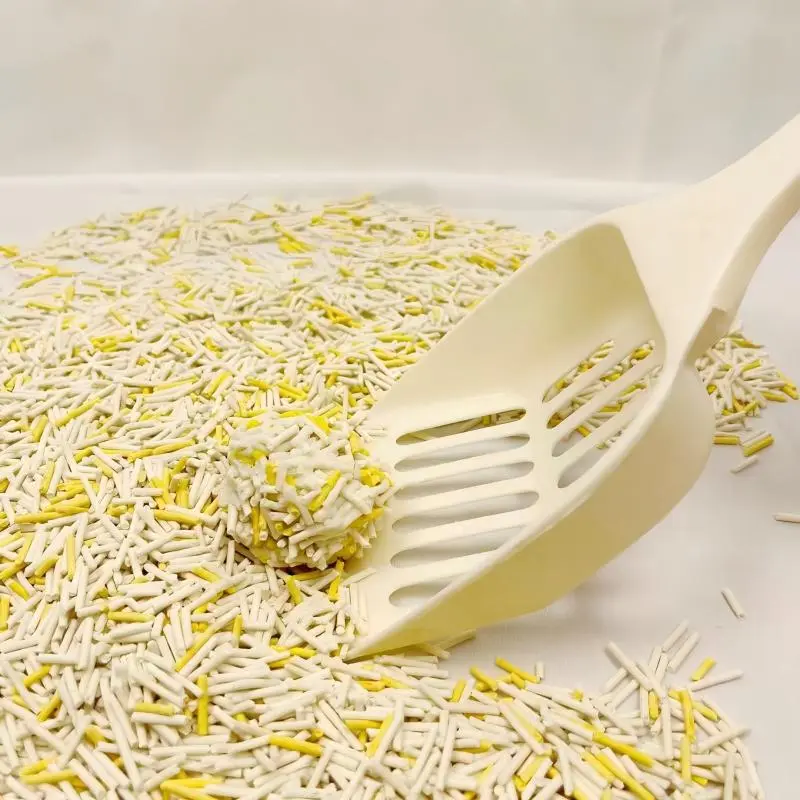
Tofu cat litter is a plant-based litter made from plant fibers and suitable binding ingredients.
Depending on the product, it can provide liquid absorption and clumping.
Some cats accept cylindrical pellets easily, while others may prefer finer granules.
When transitioning to tofu litter, observe your cat's preference rather than changing every litter box at once.
For more details about materials, specifications, and manufacturing, read our complete tofu cat litter buying guide.
9.3 Corn Cat Litter
Corn-based litter is another plant-derived option.
Its texture, absorption, and clumping depend on the complete formula and pellet design.
As with tofu litter, introduce the product gradually and observe whether your cat uses it comfortably.
9.4 Mixed Cat Litter
Mixed litter combines different materials to create a particular product structure or performance profile.
The specific formulation matters more than the product category name.
9.5 Unscented Litter
Many cats are sensitive to strong smells.
An unscented litter is a sensible starting point, especially when training a kitten or helping an adult cat adjust to a new environment.
If you are unsure which product will suit your cat, compare several options using our guide to choosing cat litter.
10. When to Contact a Veterinarian
A sudden change in elimination habits should not automatically be treated as a training problem.
Cats may avoid the litter box because of urinary, digestive, mobility, or other health problems.
Contact your veterinarian if your cat:
Suddenly stops using the litter box.
Urinates much more or less frequently than usual.
Has blood in its urine or stool.
Appears uncomfortable while eliminating.
Has persistent diarrhea or constipation.
Repeatedly enters the tray without producing normal amounts.
Shows changes in appetite, activity, or behavior.
Important emergency warning: If your cat repeatedly strains to urinate but produces little or no urine, seek immediate veterinary attention. A urinary blockage can be life-threatening, particularly in male cats. Do not wait for litter training to improve or try a different litter product first.
11. Frequently Asked Questions About Toilet Training Cats
Q1. How long does it take to toilet train a cat?
Many kittens learn to use a litter box quickly once they have a suitable tray and a comfortable environment. Newly adopted adult cats may need more time, especially if they are unfamiliar with indoor litter boxes. The timeline depends on age, previous experience, health, and environment.
Q2. Can you train a cat to use a human toilet?
Some cats can learn to use a human toilet with a specialized training system. However, this is generally not recommended as a replacement for a normal litter box because it restricts digging and covering, makes health monitoring more difficult, and may create accessibility problems.
Q3. Is it better to toilet train a cat or use a litter box?
A normal litter box is generally the better long-term choice. It supports natural elimination behaviors, is easier for kittens and senior cats to access, and allows owners to monitor urine and stool changes.
Q4. At what age should you start litter training a kitten?
You can introduce a suitable litter tray as kittens become mobile and begin the weaning process. Very young kittens that are still dependent on their mother need different care. Choose a low-entry tray and age-appropriate litter.
Q5. How do I train an adult cat to use a litter box?
Start by providing a quiet, accessible area with a sufficiently large litter box. Use a familiar or acceptable litter texture, keep the location consistent, and reward normal use calmly. If an adult cat suddenly stops using its box, consult a veterinarian to rule out medical problems.
Q6. Why is my cat pooping or peeing outside the litter box?
Possible causes include a dirty or unsuitable box, disliked litter, poor placement, social stress, mobility problems, or illness. Repeated or sudden house-soiling should be evaluated by a veterinarian.
Q7. Should I put my cat in the litter box after meals?
You can offer your cat access to the tray after meals and naps, when elimination may be more likely. However, do not hold the cat inside or force it to stay. Let the cat investigate and leave freely.
Q8. Should I punish my cat for using the floor instead of the litter box?
No. Punishment can increase stress and make litter box avoidance worse. Clean the area thoroughly, identify what caused the accident, and make the litter box more comfortable and accessible.
Q9. How many litter boxes should I have?
A common starting recommendation is one litter box per cat, plus one extra. Place them in separate locations so that cats have convenient access and can avoid competition.
Q10. Can I flush tofu cat litter down the toilet?
Do not assume that all tofu cat litter is suitable for flushing. Even products marketed as flushable may not be permitted by local wastewater or septic-system rules. For example, the US EPA advises against flushing cat litter into septic systems. Follow the product label and local disposal requirements.
Q11. What type of litter is best for toilet training a kitten?
Start with an unscented, kitten-appropriate litter that the kitten can comfortably dig in. Very young kittens that may ingest litter need special consideration; ask your veterinarian about a suitable non-clumping option.
Q12. Can I use a toilet training kit if my cat already knows how to use a litter box?
Training kits are available, but the ability to learn does not mean human toilet training is the best long-term choice. Keeping a conventional litter box is generally easier, safer, and more compatible with normal veterinary care, travel, and aging.
Conclusion: Build Healthy Toilet Habits with a Proper Litter Box
Learning how to toilet train a cat should begin with understanding the cat's natural elimination behavior.
For most households, the best approach is to provide a clean, accessible litter box, choose a suitable litter, establish a predictable routine, and encourage good habits through patience and positive reinforcement.
Training a cat to use a human toilet may seem convenient, but it can remove the opportunity to dig and cover waste, make health monitoring more difficult, and create problems as a cat ages.
A conventional litter box remains the more practical long-term solution for most cats.
Gelin Town Pet provides different cat litter products, including tofu, corn, mixed, and plant-based formulas, for pet owners and international pet brands.
Explore our cat litter product range, learn more about our cat litter manufacturing facilities, or contact Gelin Town Pet for product information and wholesale inquiries.