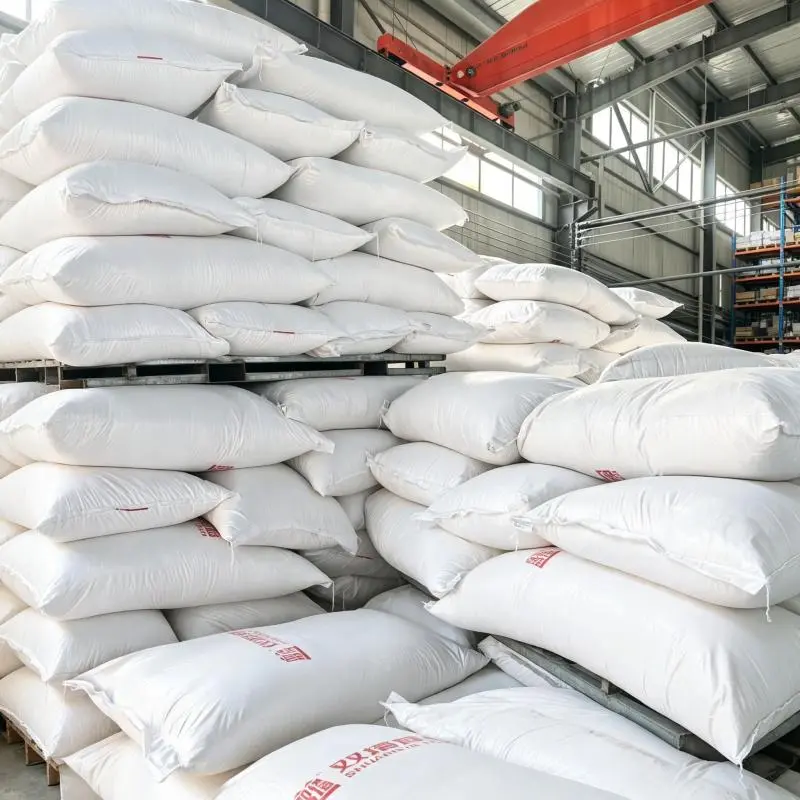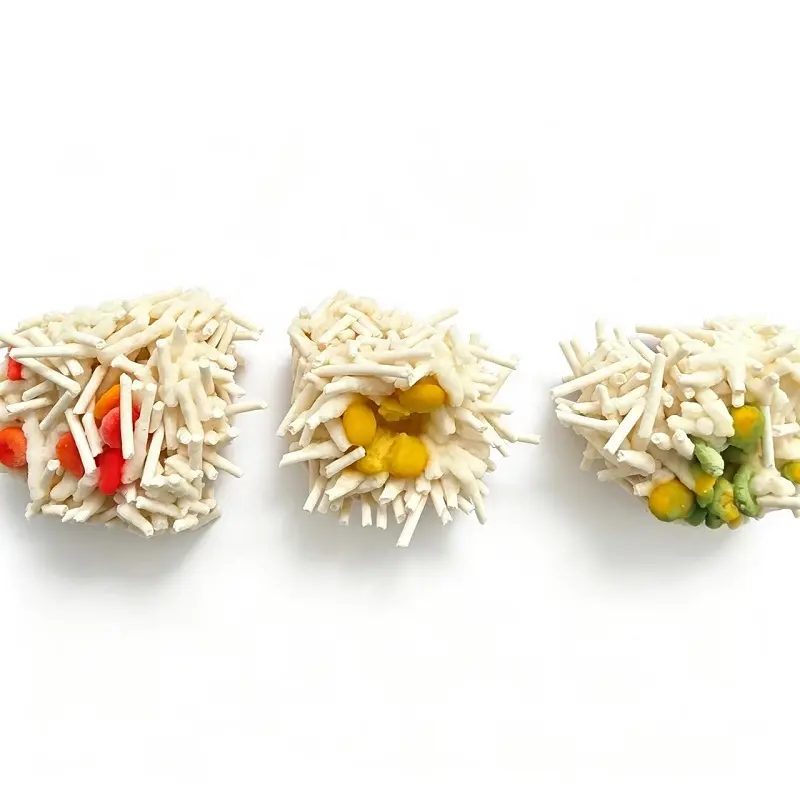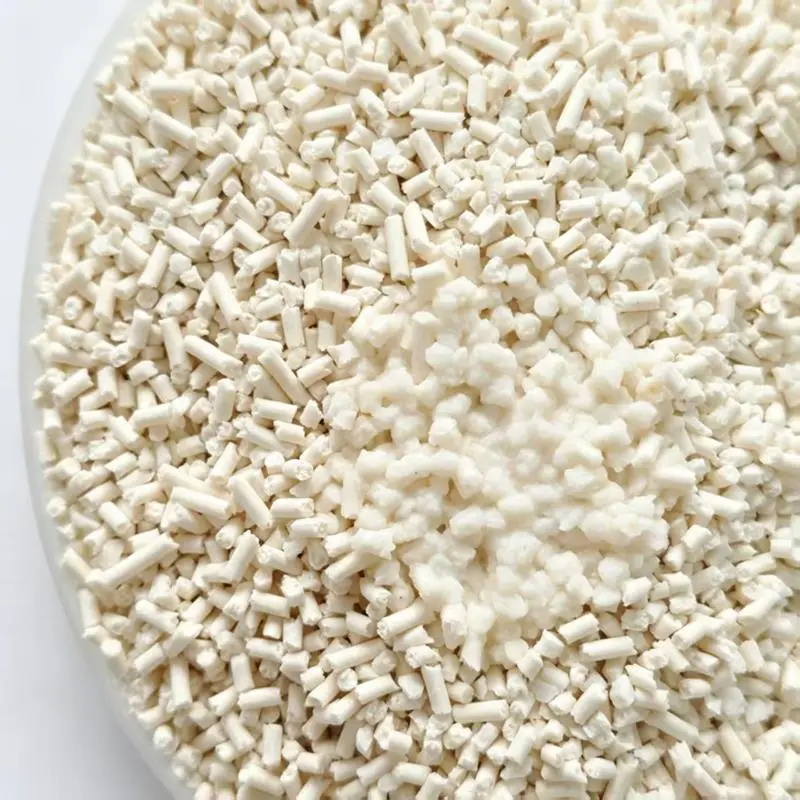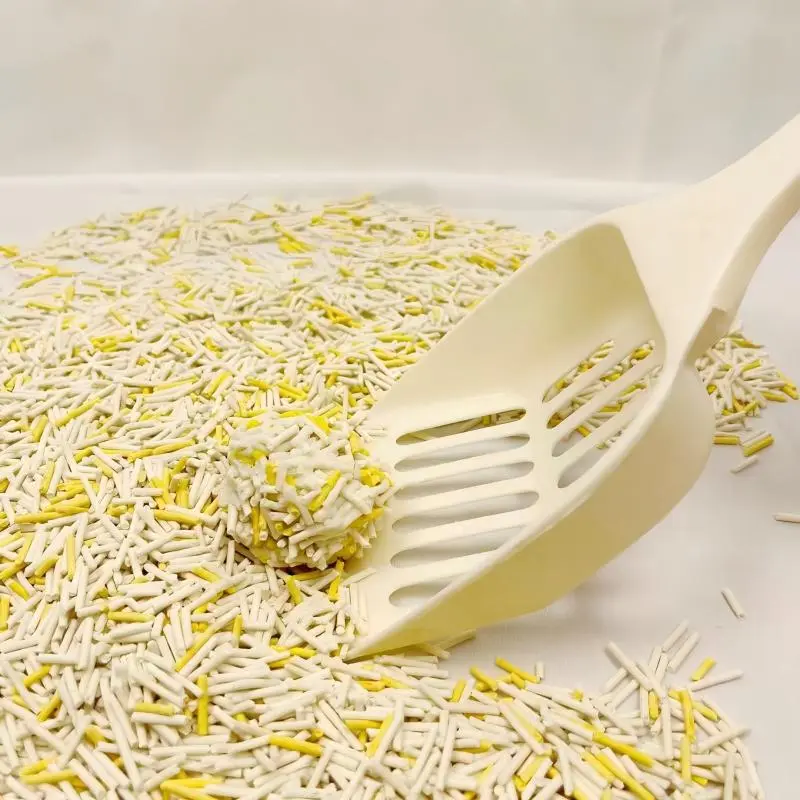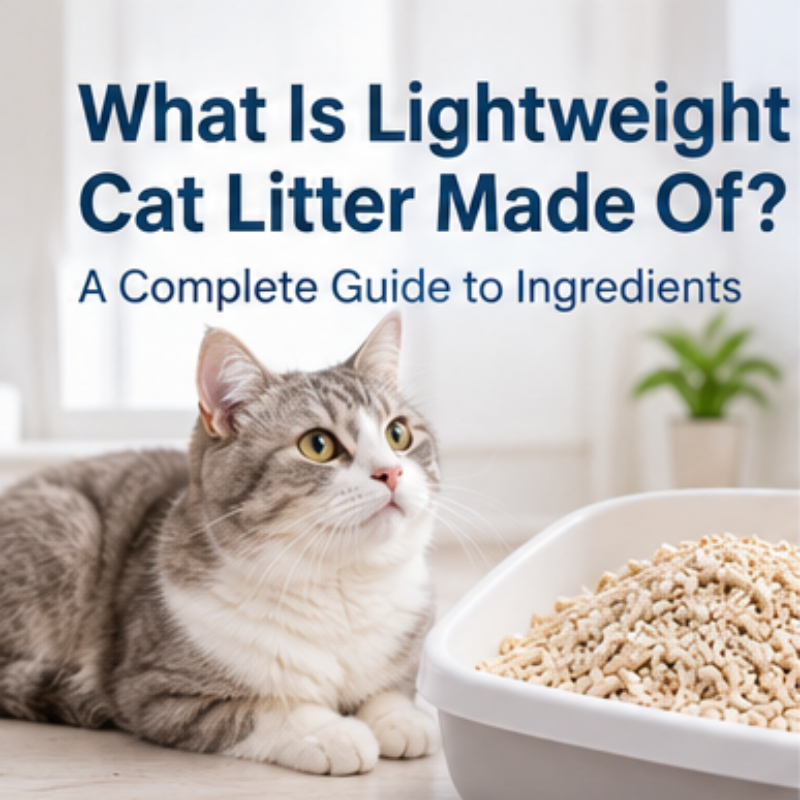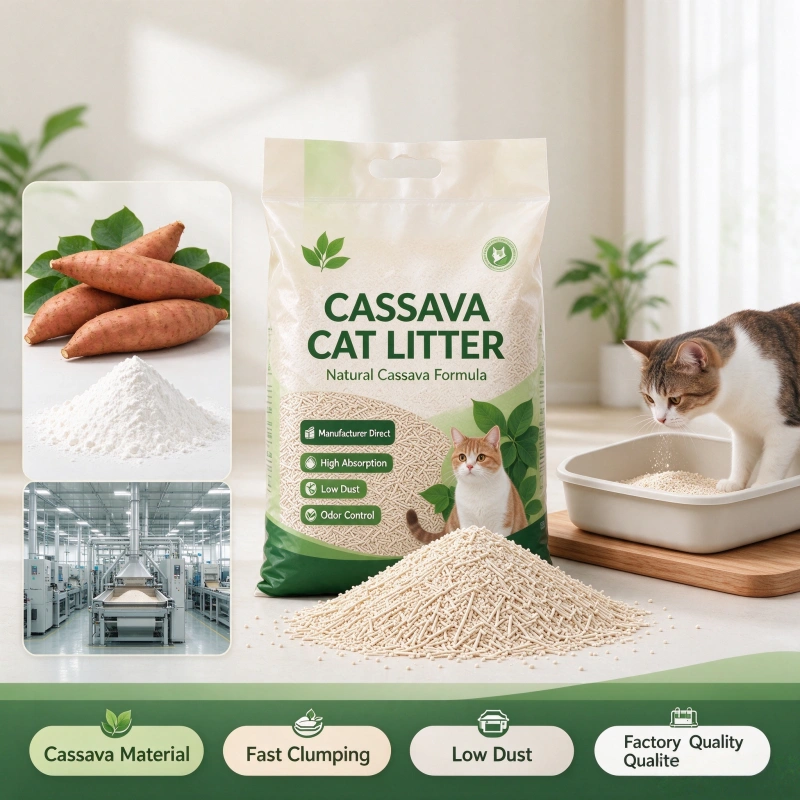
Choosing the right cassava cat litter manufacturer is an important decision for pet product importers, wholesalers, distributors, and private-label brands. A reliable supplier should do more than provide plant-based cat litter. It should offer consistent raw materials, controlled manufacturing processes, measurable product specifications, dependable packaging, and flexible OEM/ODM services.
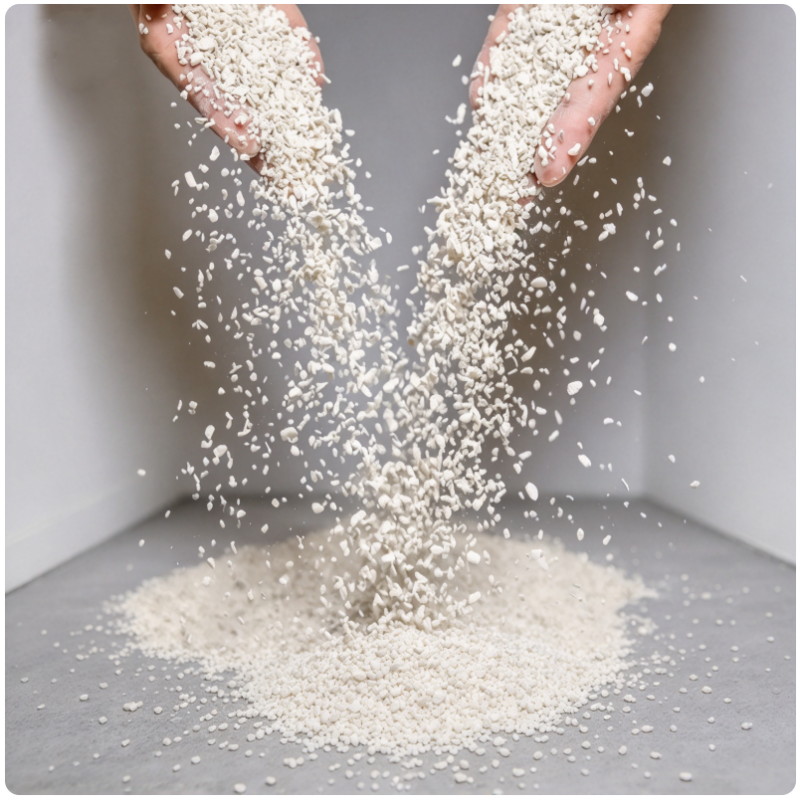
Cassava cat litter is a plant-based alternative to conventional mineral litter. Made primarily from cassava-derived starch, it can be formulated into granules designed to absorb moisture and form removable clumps. Depending on the formulation, manufacturers may also use corn starch, binders, or other functional ingredients to achieve specific product characteristics.
However, not all cassava cat litter products perform alike. Particle size, moisture content, bulk density, absorption, clumping strength, dust, and storage stability can vary considerably between manufacturers.
This guide explains how cassava cat litter is manufactured, which specifications B2B buyers should evaluate, how to test product quality, and what to consider when choosing a Chinese factory for wholesale, OEM, or private-label production.
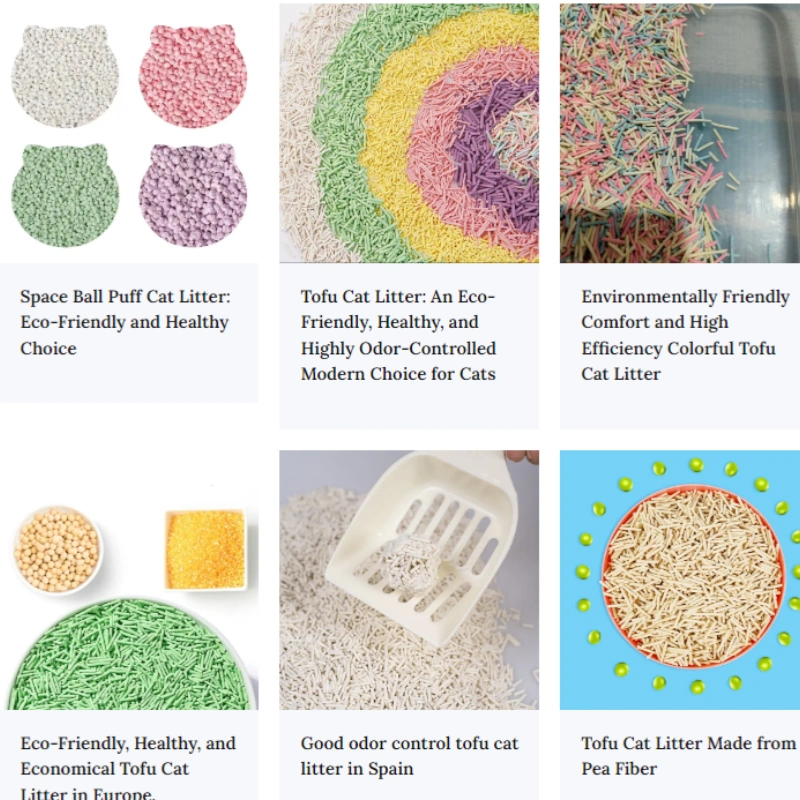
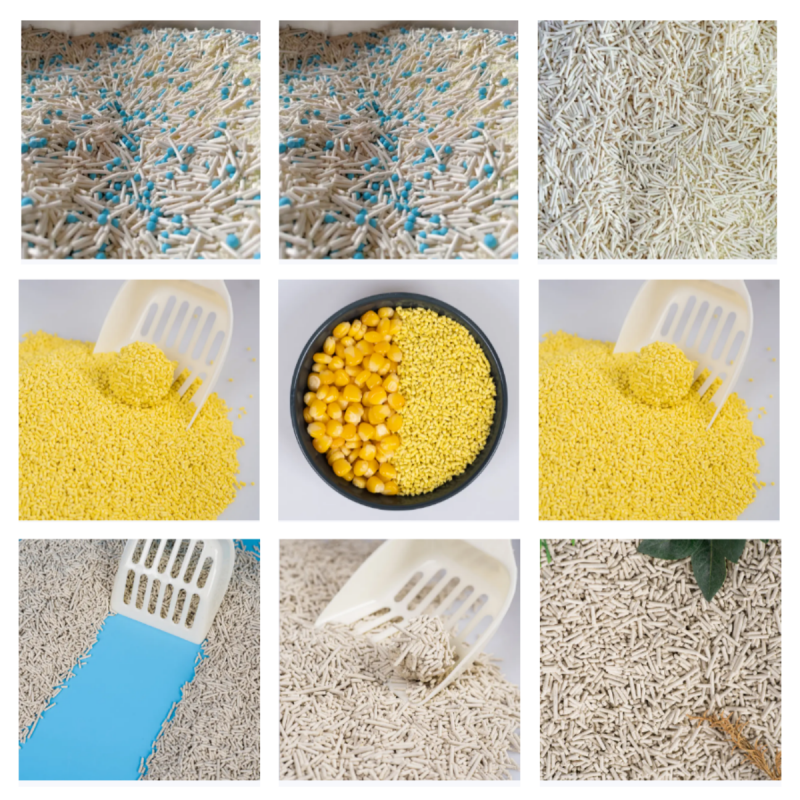
Gelin Town Pet is a plant-based cat litter manufacturer in Shandong, China, offering cassava cat litter alongside tofu, corn, cereal, peanut shell, and mixed cat litter products. We work with international customers to develop product specifications and packaging according to different market requirements.
What Is Cassava Cat Litter?
Cassava cat litter, also known as tapioca cat litter, is a plant-based litter made using processed cassava materials, particularly cassava starch.
Cassava (Manihot esculenta) is a tropical root crop. Its starch has binding and thickening properties that make it useful in various industrial formulations.
In cat litter manufacturing, cassava starch can be processed into granules that absorb moisture and form clumps when exposed to liquid.
Depending on the manufacturer and product grade, a cassava cat litter formula may contain:
| Raw material | Role in the formulation |
|---|---|
| Cassava starch | Provides the primary starch-based material and contributes to particle formation |
| Corn starch | Can support binding and granule formation |
| Plant-based fibers | May influence particle structure and physical performance |
| Guar gum or other binders | May improve cohesion and influence clumping behavior |
| Functional additives | May be included for specific odor-management or product requirements |
Not every cassava cat litter uses all these ingredients. Some products rely mainly on cassava and corn starch, while others use additional fibers or binders.
For this reason, importers should request the complete ingredient declaration and approved formulation instead of assuming that every product marketed as cassava litter has the same composition.
Explore our cassava cat litter product range to learn more about our product options.
Why Are More Pet Brands Considering Cassava Cat Litter?
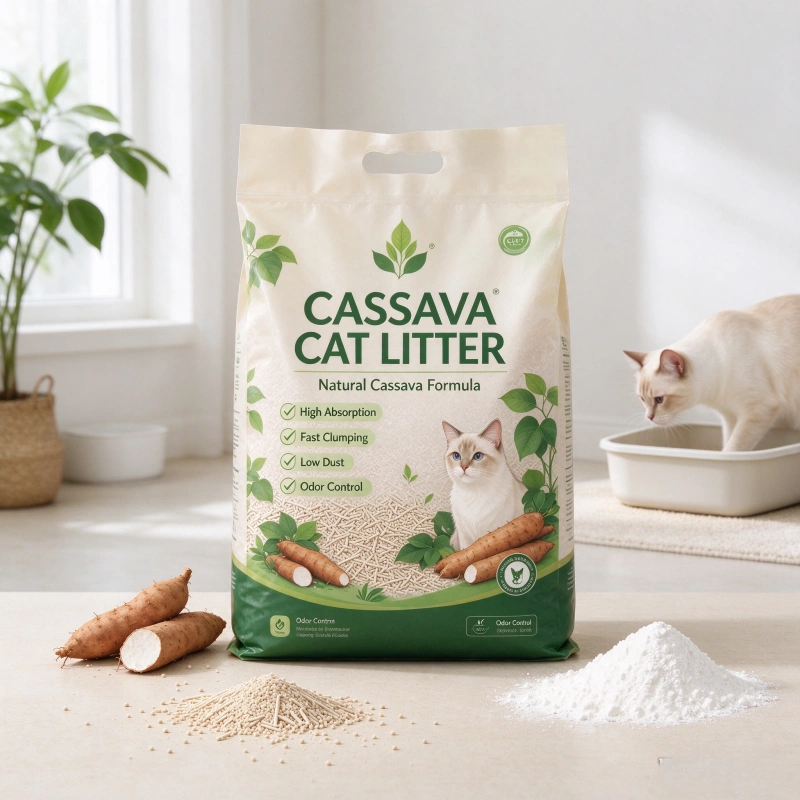
Cassava cat litter gives manufacturers and retailers another option for developing plant-based cat litter products.
Its potential commercial advantages include a distinctive raw material story, different particle formats, and the ability to develop clumping formulations for customers seeking alternatives to traditional bentonite clay.
However, a successful product line requires more than choosing a different ingredient.
1. A plant-derived raw material
Cassava starch provides an alternative to conventional mineral-based litter materials.
For brands developing plant-based product lines, it offers another formulation direction alongside tofu, corn, wood, and other agricultural materials.
The environmental benefits should still be assessed at the product level. Raw material sourcing, manufacturing energy, packaging, transportation, consumption, and disposal all influence the overall environmental impact.
2. A flexible particle structure
Cassava cat litter can be manufactured in different particle sizes and forms.
Depending on the formulation and processing method, manufacturers may develop:
Fine-granule cassava litter.
Rounded or spherical granules.
Irregular crushed granules.
Small-diameter particles.
Customized particle sizes for specific retail channels.
These options give private-label brands more flexibility when developing products for different customers.
For example, fine granules may appeal to cats accustomed to sand-like textures, while larger particles may provide a different handling and tracking experience.
Neither format is automatically superior. The finished product should be evaluated for cat acceptance, dust, absorption, clumping, and tracking.
3. Clumping and easy cleaning
Cassava starch can contribute to a formulation designed to absorb moisture and form removable clumps.
The performance depends on the complete ingredient system and production conditions.
Buyers should evaluate how quickly the litter forms a clump, whether the clump remains intact when lifted, and how much wet residue stays on the tray.
4. Opportunities for premium private-label positioning
Cassava litter can help retailers develop a differentiated plant-based product alongside existing tofu, corn, and mineral litter products.
A premium product strategy may focus on particle appearance, texture, dust performance, packaging, fragrance options, and verified product specifications.
For a wider understanding of plant-derived materials, explore our plant-based cat litter range.
How Is Cassava Cat Litter Manufactured?
The manufacturing process has a direct influence on particle consistency, clumping behavior, dust, and finished-product stability.
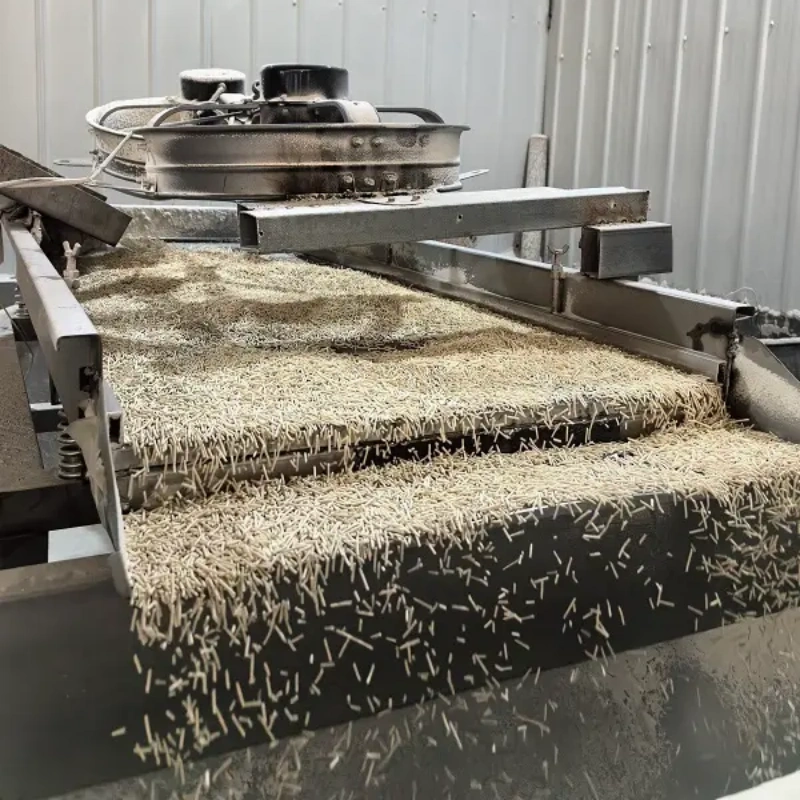
At Gelin Town Pet, the development of cassava cat litter follows a production process involving raw material preparation, formulation mixing, granulation, drying, screening, and packaging.
The exact parameters depend on the formula, equipment, and target product specifications.
Step 1: Raw material preparation and inspection
Cassava starch and other selected ingredients should be inspected before entering production.
Important incoming-material checks may include:
Raw material identification and batch traceability.
Appearance and color.
Moisture content.
Particle size or material consistency.
Packaging condition.
Supplier documentation and applicable test reports.
Raw material consistency is important because changes in starch properties or moisture can affect the mixing and granulation process.
Step 2: Formula preparation and mixing
Cassava starch is combined with other ingredients according to the approved formulation.
Depending on the product, the mixture may include corn starch, binders, or other functional components.
The mixing process should provide consistent ingredient distribution. Uneven mixing can cause variations in particle formation, clumping, and finished-product quality.
Water addition also requires control. Too much or too little moisture can influence the behavior of the mixture during granulation and subsequent drying.
Step 3: Extrusion and granule formation
After mixing, the prepared material is processed through suitable granulation or extrusion equipment.
The equipment forms the mixture into granules or pellets with the required dimensions and structure.
Important process variables may include:
Material moisture before granulation.
Feeding consistency.
Extrusion or forming conditions.
Die dimensions.
Granule cutting length.
Production speed.
For customized products, the granule diameter and length should be agreed before production. Changing the particle structure may require adjustments to the formulation or production settings.
Step 4: Drying
Freshly formed granules contain moisture that needs to be reduced to the specified finished-product level.
Drying conditions influence final moisture, granule hardness, particle stability, and storage performance.
Under-drying may leave excessive moisture, while overly aggressive drying may cause cracking or increased breakage in some formulations.
Manufacturers should establish suitable drying conditions through production trials rather than applying one fixed temperature and drying time to every formula.
Step 5: Screening and dust removal
After drying, the granules are screened to separate particles according to the required size range.
Screening and dust-removal processes can help reduce:
Excessive fines.
Broken granules.
Oversized particles.
Irregular material.
This stage is important for controlling the consistency of the finished product.
Step 6: Cooling and packaging
The granules should be brought to suitable packaging conditions before filling.
Packaging protects the product from transportation damage and environmental moisture exposure.
The manufacturer should check filling weight, bag sealing, packaging appearance, batch identification, and finished-product consistency before shipment.
For a more detailed explanation, read our guide to the manufacturing process of cassava cat litter.
Cassava Cat Litter Specifications: What Should Buyers Check?
Technical specifications help importers compare suppliers and determine whether a product is suitable for their intended market.
However, a single specification cannot predict the entire performance of cat litter. Buyers should evaluate the combination of ingredient composition, particle dimensions, moisture, absorption, clumping, dust, and bulk density.
1. Ingredients and formulation
Ask the manufacturer for the complete ingredient declaration.
Do not assume that all cassava cat litter is made from 100% cassava. Some formulas combine cassava starch with corn starch, while others include fibers or binders.
The ingredient declaration is particularly important when a brand wants to make claims about mineral content, plant-based materials, or specific additives.
2. Particle size and shape
Particle dimensions influence texture, handling, tracking, and product appearance.
Common supplier listings show different commercial formats, including fine granules around 0.5–2 mm and larger particle sizes up to 3 mm. These are examples of available market specifications, not universal industry standards.
For cylindrical products, diameter and length should both be defined. For crushed or irregular granules, a particle-size distribution is more useful.
3. Moisture content
Moisture content affects product weight, storage stability, and consistency.
Buyers should request a numerical specification and the method used to measure it.
A low moisture result is not automatically better in every context. The acceptable range should be agreed according to the specific formulation, drying process, and packaging conditions.
4. Bulk density
Bulk density is the mass of litter contained in a given volume.
It is important for:
Packaging calculations.
Freight planning.
Warehouse storage.
Retail pack dimensions.
Product handling.
Bulk density should be measured using a defined sample preparation and volume-measurement procedure.
5. Water absorption capacity
Water absorption indicates how much liquid the litter retains under defined conditions.
A common weight-based calculation is:
Water Absorption (%) = (Mass of Absorbed Liquid ÷ Initial Dry Sample Mass) × 100
For example, a 10 g dry sample that absorbs 30 g of liquid has a calculated absorption rate of 300%.
This is an illustrative example, not a result for Gelin Town Pet's cassava cat litter.
To compare two manufacturers fairly, use the same liquid, sample weight, exposure time, drainage procedure, and calculation method.
6. Clumping time and strength
Clumping time measures how long the litter takes to form a removable clump under defined conditions.
Clump strength evaluates whether the clump remains intact during handling and scooping.
A fast-forming clump is not necessarily a strong clump. Both indicators should be considered during product development.
7. Dust and fines content
Dust is an important consideration for households and retailers.
However, buyers should distinguish between powder or fines content and airborne dust generated during handling. They are related but different measurements.
Ask the manufacturer which test method is used and whether the reported result measures fines in the product, airborne particles, or both.
Cassava Cat Litter Specification Checklist
| Specification | What buyers should request |
|---|---|
| Main ingredients | Complete material declaration |
| Particle size | Diameter or particle-size distribution |
| Particle shape | Fine, rounded, cylindrical, or crushed |
| Moisture | Agreed numerical limit and test method |
| Bulk density | Measured value and test procedure |
| Water absorption | Percentage and complete test conditions |
| Clumping time | Defined test time |
| Clump strength | Integrity or retention test |
| Dust | Dust or fines measurement method |
| Odor control | Defined test method and supporting data |
| Packaging | Bag dimensions, weight, material, and seal |
| Batch consistency | Sampling, inspection, and traceability procedure |
How to Test Cassava Cat Litter Before Buying in Bulk
A sample should be evaluated before approving a commercial order.
The following tests provide a practical framework for comparing different manufacturers. They are proposed quality-control procedures, not claims that a particular batch has already passed.
Test 1: Water absorption test
Objective: Measure the amount of liquid absorbed by a fixed quantity of cassava litter.
Suggested procedure:
Prepare and weigh a dry sample.
Place the material in a clean test container.
Add a measured volume of test liquid.
Allow a fixed contact time.
Drain or separate the sample using an agreed method.
Measure the retained liquid or final sample weight.
Repeat the test using additional samples.
Record the liquid type, temperature, sample weight, contact time, and calculation procedure.
For commercial comparison, use the same test conditions for every supplier sample.
Test 2: Clump integrity test
Objective: Evaluate whether the litter forms a firm clump that can be removed efficiently.
Suggested procedure:
Add an equal quantity of litter to identical test trays.
Apply the same volume of test liquid.
Wait for a defined clumping period.
Remove the clump using the same scoop or testing device.
Record whether the clump stays intact or breaks apart.
Inspect the bottom of the tray for remaining wet material.
Repeat the procedure on several samples.
For an objective comparison, a test protocol can measure the percentage of clump mass retained after standardized handling or sieving.
Do not use the phrase "99% clumping strength" unless the calculation and measurement method are clearly defined.
Test 3: Dust and fines test
Objective: Evaluate the amount of fine material generated during product handling.
A controlled test should define:
Sample weight.
Handling or pouring method.
Test equipment.
Screening or particle-measurement procedure.
Calculation method.
Number of repetitions.
The report should distinguish powder content from airborne dust. A product that contains little visible powder may still release fine particles during pouring.
Test 4: Odor-control test
Objective: Compare the litter's ability to manage odor-related compounds.
For commercial testing, a qualified laboratory may use a defined ammonia challenge and measure ammonia concentration in the air above the sample at specified time points.
The report should include sample mass, test-liquid quantity, temperature, humidity, chamber volume, measurement intervals, equipment, and repetitions.
Ammonia is one odor-related indicator, not a measurement of every compound responsible for cat litter odor.
For normal household use, daily scooping and correct litter-box maintenance remain essential.
Test 5: Pellet durability test
Objective: Evaluate whether pellets break during handling, transportation, and storage.
A controlled procedure can compare fines content before and after a defined handling or agitation process.
This is particularly useful for importers who need to verify that the material remains in acceptable condition after international transportation.
Test 6: Storage and packaging test
Objective: Check whether the finished product remains stable during storage.
Evaluate:
Bag sealing.
Moisture protection.
Package leakage.
Weight consistency.
Product appearance after storage.
Changes in granule condition.
Unusual odor or visible contamination.
For longer shelf-life claims, real-time and appropriately designed accelerated storage studies may be required.
Cassava Cat Litter vs. Tofu, Corn, and Bentonite: Which Is Better for Your Market?
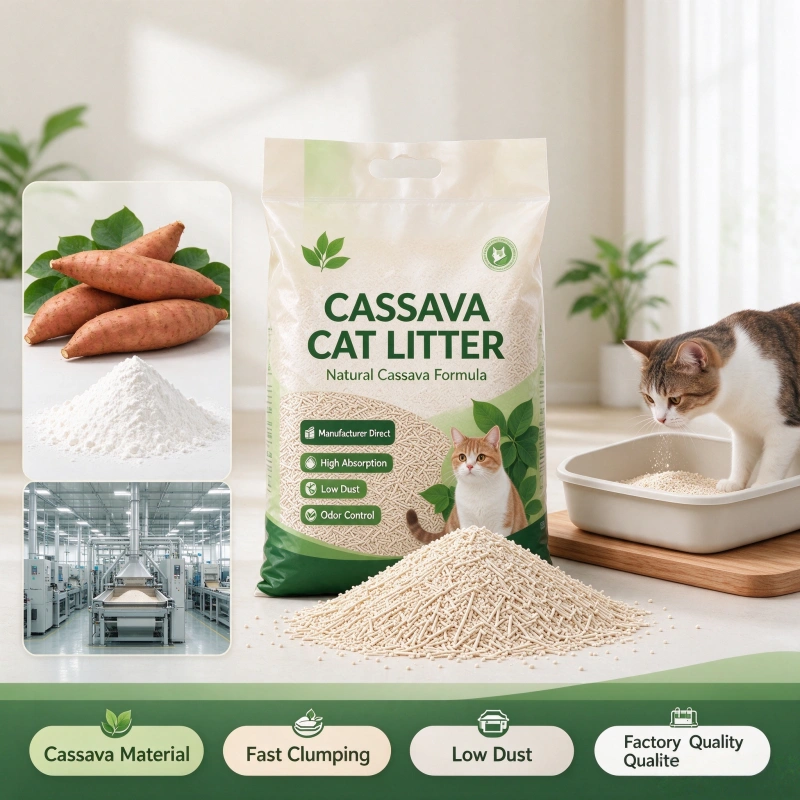
Cassava is one of several possible materials for developing a differentiated cat litter product line.
Different materials offer different particle structures, production requirements, and retail positioning.
| Comparison factor | Cassava litter | Tofu litter | Corn litter | Bentonite litter |
|---|---|---|---|---|
| Main material | Cassava-derived starch | Pea or soybean fiber and starch | Corn-derived materials | Mineral clay |
| Typical format | Fine granules or rounded particles | Cylindrical, crushed, or expanded pellets | Granules or pellets | Mineral granules |
| Clumping | Depends on formulation | Depends on formulation | Depends on formulation | Many products form strong clumps |
| Handling weight | Depends on bulk density | Depends on pellet structure | Depends on density | Often heavier |
| Dust | Product-specific | Product-specific | Product-specific | Product-specific |
| Texture | Can be fine and granular | Often pellet-based | Granules or pellets | Usually granular |
| Environmental assessment | Depends on material sourcing and full lifecycle | Depends on ingredients and processing | Depends on sourcing and manufacturing | Includes mineral extraction and disposal |
| Best product-development priority | Granule size and starch-based clumping | Fiber structure and pellet design | Absorption and formulation consistency | Clumping, dust, and price positioning |
When should buyers choose cassava cat litter?
Cassava litter is worth evaluating when the target market wants a plant-derived product with a granular texture and clumping functionality.
When is tofu cat litter a better fit?
Tofu litter may be more suitable for brands seeking a familiar plant-fiber pellet format.
Gelin Town Pet also offers tofu cat litter products, including different particle designs.
When should buyers consider corn cat litter?
Corn litter provides another plant-derived material option and may fit product ranges targeting customers who prefer corn-based ingredients.
Explore our corn cat litter range.
What about mixed-material products?
Some buyers prefer to develop mixed formulations to achieve a different balance of texture, absorption, clumping, or cost.
Our cassava mixed cat litter is another product direction worth evaluating.
For a broader comparison, explore our mixed cat litter range.
How to Choose a Reliable Cassava Cat Litter Manufacturer
Finding a manufacturer involves more than searching for the lowest factory quotation.
A reliable supplier should have the manufacturing capacity, technical knowledge, quality controls, and commercial flexibility required for repeat orders.
1. Confirm that the supplier has its own factory
A company selling cat litter may be a manufacturer, trading company, or distributor.
For larger orders, check whether the supplier operates its own production facility and whether it can explain the actual production process.
Ask for factory photographs, production videos, an audit opportunity, and details of the equipment used for mixing, granulation, drying, screening, and packing.
2. Review production and quality-control capabilities
A suitable manufacturer should be able to explain how it controls:
Raw material quality.
Formulation accuracy.
Granule dimensions.
Moisture content.
Clumping performance.
Dust and fines.
Packaging weight and sealing.
Finished-product traceability.
A supplier's ability to describe these procedures is more meaningful than using general statements such as "strict quality control" without explaining what is inspected.
3. Request technical documentation
For B2B buyers, request the documents relevant to the product and target market.
These may include:
Product technical data sheet.
Ingredient declaration.
Batch certificate of analysis.
Dust and absorption test results.
Clumping performance report.
Microbiological testing where appropriate.
Safety data information, where applicable.
Packaging specifications.
Applicable company and product certificates.
Always check the certificate holder, issuing organization, validity period, and scope. A company-level certification does not automatically certify every cat litter formula.
4. Check production capacity and repeat-order consistency
A supplier may produce a satisfactory sample but struggle to maintain the same quality during large-scale manufacturing.
Ask how batch numbers are tracked and whether the manufacturer retains reference samples.
For repeat orders, compare the finished products against the approved specifications rather than relying only on the original sample.
5. Evaluate commercial conditions
Before placing an order, confirm:
Minimum order quantity.
Sample and courier costs.
Production lead time.
Packaging options.
Payment terms.
Container loading quantity.
Inspection arrangements.
Shipping documents.
Procedures for handling nonconforming goods.
A detailed quotation should identify the actual product specification and packaging configuration, not simply state a price per bag.
Gelin Town Pet: Cassava Cat Litter Manufacturer in China
Gelin Town Pet is a plant-based cat litter manufacturer based in Shandong, China.
Established in 2020, Shandong Gelin Town Pet Products Co., Ltd. operates its own production facility and develops different cat litter materials for international B2B customers.
According to the company's published factory information:
| Company information | Published details |
|---|---|
| Company | Shandong Gelin Town Pet Products Co., Ltd. |
| Established | 2020 |
| Location | Shandong, China |
| Production area | Approximately 16,000 m² |
| Annual production capacity | Approximately 7,000 tons |
| Main product categories | Plant-based, tofu, corn, cassava, cereal, mixed, and health-monitoring litter |
| Business services | Wholesale, OEM, ODM, and private-label packaging |
Our cat litter factory is equipped with production and packaging equipment for different plant-based cat litter formats.
Learn more about our company background and manufacturing capabilities.
Gelin Town Pet Cassava Cat Litter Specifications
The current cassava product pages publish the following information.
| Specification | Published information |
|---|---|
| Product material | Cassava |
| European product material description | Cassava starch and corn starch |
| Product form | Granules |
| Product color | Customized |
| Package options | 6L/2.5kg, 7L/2.8kg, 10L/4.5kg |
| Customized packaging | Available upon confirmation |
| OEM | Available |
| Country of origin | China |
| Listed MOQ | 1 × 20-foot FCL |
| Listed payment terms | T/T |
The current public product pages do not provide a complete set of numerical dust, absorption, and clumping test results for this specific cassava product.
We recommend confirming the current technical data sheet and testing requirements with our team before approving a commercial specification.
Cassava Product Development for Different Markets
Different countries and sales channels may require different particle formats and product positioning.
For example, buyers may prefer fine granules, rounded particles, customized colors, or particular package sizes.
Gelin Town Pet's existing content includes a cassava cat litter product introduction for Norway and a separate plant-based cassava cat litter overview for Europe.
These pages provide additional product information, but individual performance claims should be supported by the current SKU's test documents.
OEM and Private-Label Cassava Cat Litter Manufacturing
For importers, distributors, wholesalers, and online pet brands, OEM and private-label manufacturing can simplify the development of a new cassava cat litter product.
Instead of managing raw materials, production, packaging, and export separately, buyers can work with one manufacturing partner to establish the product specification and packaging plan.
1. Formula and material customization
Depending on the product and manufacturing feasibility, customization may involve:
Cassava starch and other plant-derived ingredients.
Binder selection and formulation ratios.
Granule diameter.
Particle shape.
Fragrance or unscented options.
Color.
Absorption and clumping targets.
Dust and fines requirements.
Any formulation change should be evaluated using representative samples before approving bulk production.
2. Packaging customization
Gelin Town Pet lists 6L/2.5kg, 7L/2.8kg, and 10L/4.5kg packaging options for its cassava cat litter, with customized specifications available by arrangement.
For a private-label project, buyers should confirm:
Bag dimensions.
Net weight and volume.
Packaging material.
Moisture protection.
Zipper or resealable options.
Logo and artwork.
Barcode and product information.
Outer carton and pallet configuration.
Liters and kilograms are different measurements. Always confirm both volume and net weight rather than assuming that one can be converted into the other without product-specific density information.
3. Private-label development process
A typical OEM project follows these steps:
Step 1: Define the target market.
Confirm the country, customer group, product positioning, target retail price, and expected order volume.
Step 2: Agree on product requirements.
Specify the formulation, granule size, color, fragrance, absorption target, clumping performance, and packaging.
Step 3: Request and test samples.
Evaluate the product using agreed testing procedures. Check whether the sample meets the intended requirements.
Step 4: Approve the specification.
Confirm the final formula, technical data sheet, product label, and acceptance criteria.
Step 5: Confirm production and inspection.
Agree on the batch inspection plan, packaging, MOQ, production schedule, payment, and shipping arrangements.
Step 6: Arrange repeat-order controls.
Retain an approved reference sample and record the finished-product specifications to support consistency across future orders.
4. Environmental claims and destination-market requirements
Cassava-based litter can be positioned as a plant-derived product, but the words "biodegradable," "compostable," and "flushable" should not be used as interchangeable descriptions.
A plant-based material may break down under certain conditions without necessarily being accepted by every composting facility or wastewater system.
Gelin Town Pet's cassava cat litter FAQ advises against flushing it because of potential plumbing problems. Follow the finished product's instructions and the applicable local disposal rules.
For brands selling in the European Union, Directive (EU) 2024/825 began applying on 27 September 2026. Environmental marketing claims should be specific, truthful, and supported by appropriate evidence.
A clear statement about the product's cassava-derived ingredients is preferable to an unsupported claim that it is completely eco-friendly or suitable for all disposal systems.
Frequently Asked Questions About Cassava Cat Litter Manufacturers
What is a cassava cat litter manufacturer?
A cassava cat litter manufacturer processes cassava-based raw materials into finished litter granules. Depending on its capabilities, the factory may also provide formulation development, granulation, drying, screening, quality inspection, packaging, and private-label manufacturing.
What is cassava cat litter made from?
Cassava cat litter is primarily made from processed cassava-derived materials, particularly cassava starch. Depending on the formula, corn starch, plant fibers, guar gum, or other functional ingredients may also be used.
Always request the complete ingredient declaration for the specific product.
How is cassava cat litter manufactured?
The typical manufacturing process includes raw material preparation, ingredient mixing, granulation or extrusion, drying, screening, cooling, and packaging.
Each process needs suitable controls to maintain granule dimensions, moisture, durability, and finished-product consistency.
Does cassava cat litter clump well?
Cassava starch-based formulas can be developed to absorb moisture and form removable clumps. Actual performance depends on the ingredient proportions, binder system, granule structure, and manufacturing process.
Ask for a clump-strength test rather than relying only on a fast-clumping claim.
Is cassava cat litter dust-free?
No plant-based litter should automatically be described as completely dust-free. Dust generation depends on particle size, manufacturing, screening, packaging, transportation, and handling.
Buyers should request the manufacturer's dust measurement method and supporting results.
Is cassava cat litter biodegradable?
Some cassava-based formulations may biodegrade under appropriate conditions. However, the finished product's biodegradability should be supported by relevant test evidence.
The rate and extent of decomposition depend on the formula and environmental conditions.
Can cassava cat litter be flushed down the toilet?
Do not assume that all cassava cat litter is flushable. Even if material disperses in water, it may still cause plumbing or wastewater problems.
Gelin Town Pet generally recommends against flushing its cassava litter. Follow product instructions and local disposal regulations.
What is the MOQ for Gelin Town Pet cassava cat litter?
The manufacturer's published MOQ for its cassava cat litter is one 20-foot full container. Confirm the current loading quantity, package configuration, and order terms directly with the sales team.
What packaging options are available?
Published options include 6L/2.5kg, 7L/2.8kg, and 10L/4.5kg, with customized packaging available upon confirmation.
Can Gelin Town Pet develop private-label cassava cat litter?
Yes. Gelin Town Pet lists OEM and private-label support. Buyers can discuss material selection, particle specifications, packaging, product requirements, and the applicable production terms.
Final Recommendation: Choose a Manufacturer That Can Prove Product Consistency
Choosing the right cassava cat litter manufacturer is not simply about finding a factory that offers plant-based litter at a competitive price.
A dependable manufacturing partner should understand raw material selection, formulation development, granulation, drying, screening, dust control, product testing, and packaging.
For importers and private-label brands, the most important step is to establish a clear technical specification before placing a large order.
Compare representative samples, request documented test methods, verify packaging requirements, and establish how each production batch will be inspected.
Gelin Town Pet manufactures cassava cat litter and other plant-based products for international B2B customers. With an approximately 16,000 m² production facility, an annual production capacity of around 7,000 tons, and OEM/ODM services, we support customers developing cat litter products for different markets and distribution channels.
If you are looking for a cassava cat litter manufacturer in China, contact Gelin Town Pet to discuss your target market, product specification, packaging requirements, and wholesale order plan.