Cassava Cat Litter Pros and Cons: Is It a Good Choice for Your Cat?
Choosing the right cat litter can make a noticeable difference in everyday cleaning, odor management, and household convenience. While bentonite clay remains a familiar option for many cat owners, plant-based alternatives have attracted increasing attention. One option worth considering is cassava cat litter.
Made primarily from cassava-derived starch, this type of litter is designed to offer a lightweight, plant-based alternative to traditional mineral litter. Its natural starch content can help bind particles together when exposed to moisture, making clumping an important feature of many cassava-based formulations.
However, cassava cat litter is not perfect for every household. It can cost more than conventional clay litter, some formulas may track outside the litter box, and organic materials require careful storage to prevent moisture-related problems.
So, what are the actual cassava cat litter pros and cons? Is it better than tofu or bentonite litter? And what should you check before switching?
This guide examines the benefits, limitations, performance factors, and purchasing considerations to help you make an informed decision.
What Is Cassava Cat Litter?
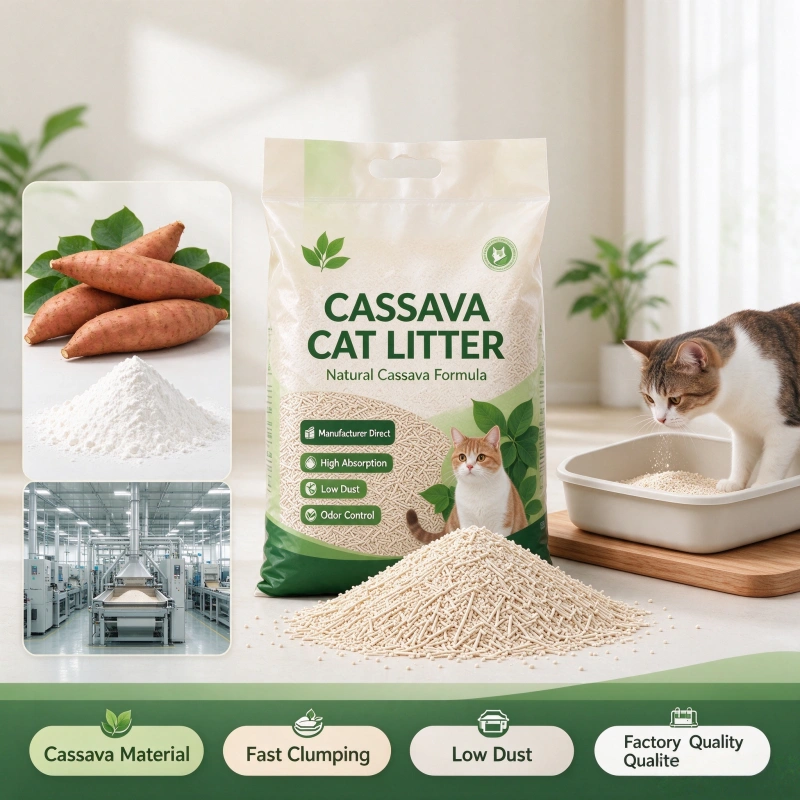
Cassava cat litter is a plant-based litter made primarily from processed cassava starch, also known as tapioca starch. Cassava is a tropical root crop widely used in food and industrial starch applications.
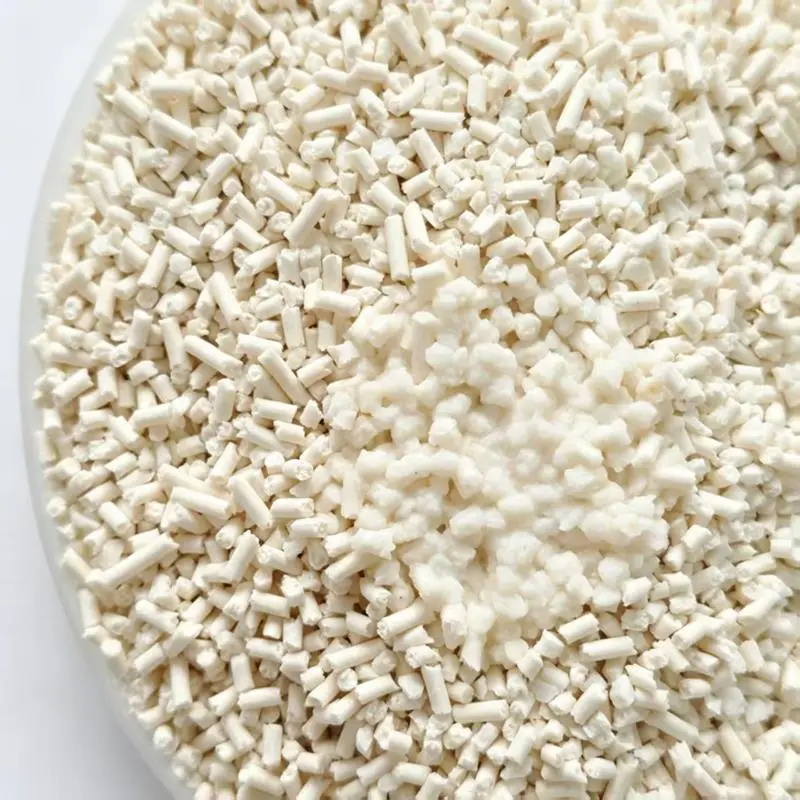
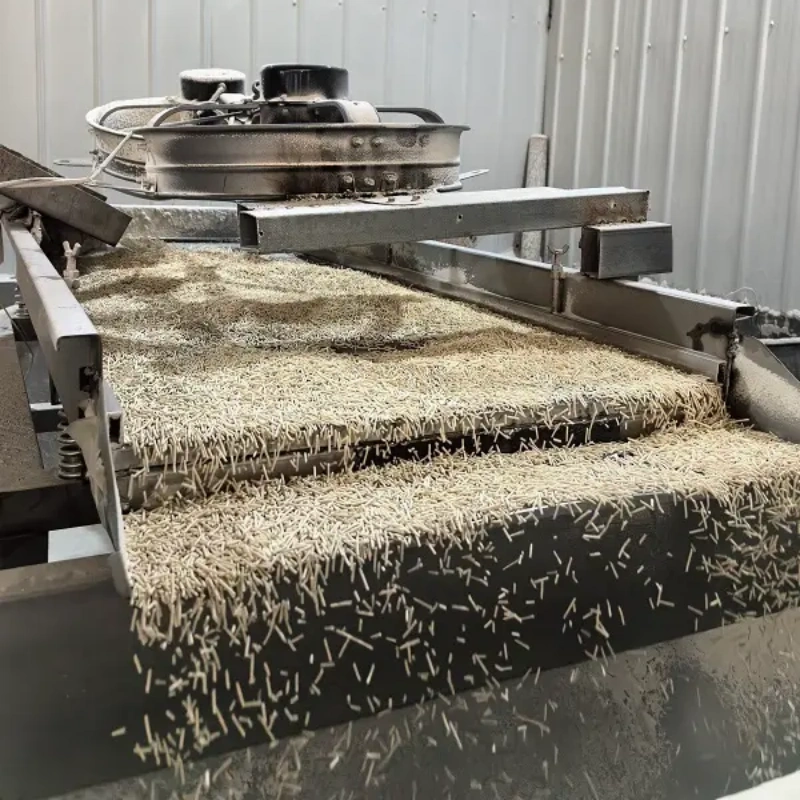
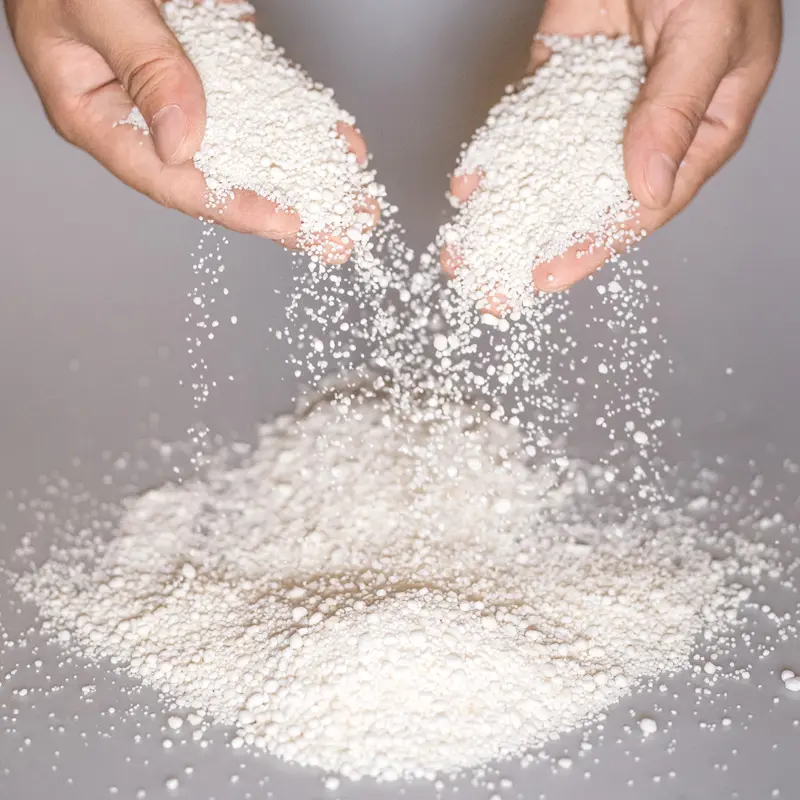
During manufacturing, cassava-derived ingredients are processed into granules or pellets suitable for use in a litter box. Depending on the formulation, manufacturers may combine cassava starch with corn starch or other binding ingredients to improve particle structure and clumping performance.
Unlike traditional bentonite litter, which is made from mined clay, cassava litter uses a plant-derived raw material.
Its main characteristics generally include:
Plant-derived raw materials.
Lightweight granules or pellets.
Starch-based clumping properties.
Potentially lower dust levels, depending on processing.
A renewable agricultural raw-material source.
Different particle sizes, colors, and packaging formats.
Not every product has the same composition. Some products marketed as cassava cat litter use cassava as the main ingredient, while others combine cassava with corn starch or additional ingredients.
For example, Gelin Town Pet offers cassava cat litter products with customized packaging and OEM options. Buyers should review the actual ingredient declaration and technical specifications rather than relying on the product name alone.
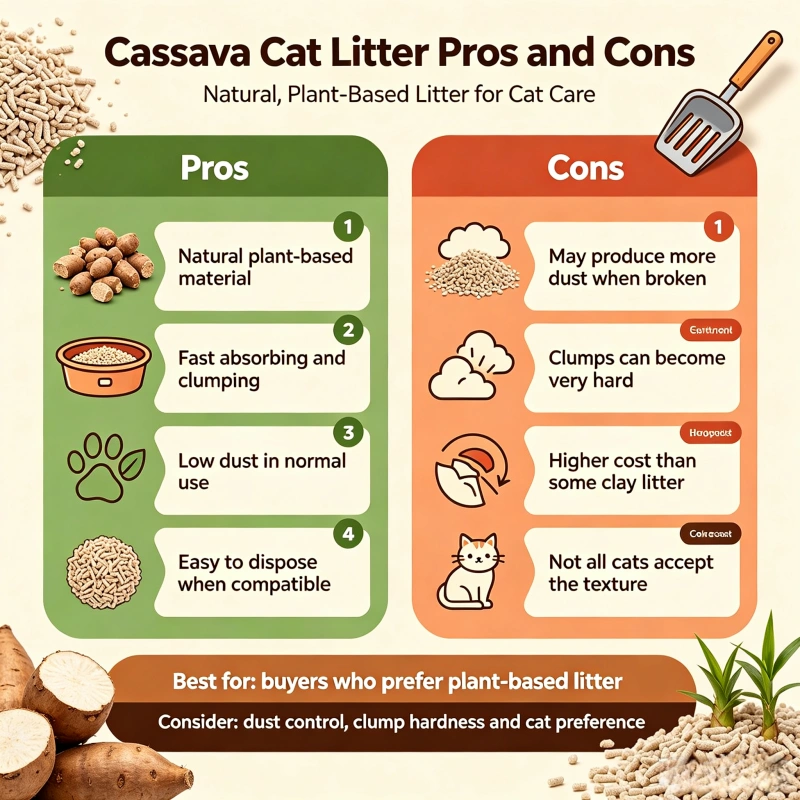
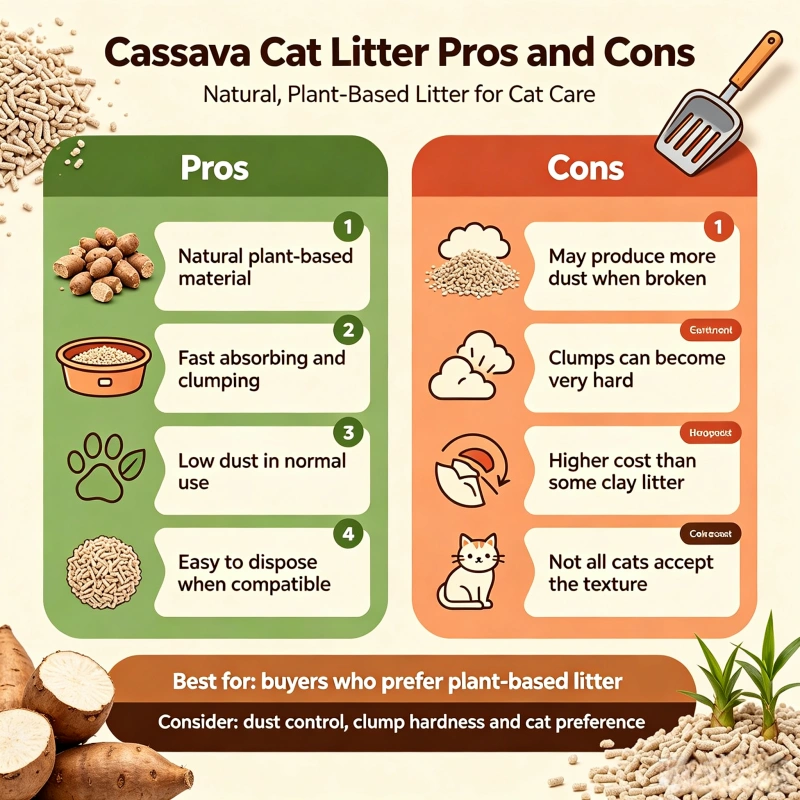
Cassava Cat Litter Pros and Cons at a Glance
Before looking at each feature in detail, here is a quick overview.
| Advantages | Disadvantages |
|---|---|
| Made primarily from plant-derived materials | Often more expensive than conventional clay litter |
| Lightweight and convenient to handle | Fine particles may track outside the litter box |
| Starch can support natural clumping | Clump strength varies by formulation |
| Can produce relatively little dust when properly processed | Dust performance depends on manufacturing and handling |
| Renewable agricultural raw-material source | Agricultural production still has environmental impacts |
| Some formulas may be suitable for specific disposal or composting systems | Flushability and compostability cannot be assumed |
| Different particle sizes and packaging options | Availability may be more limited in some markets |
| Can be developed for private-label brands | Moisture-sensitive products require proper storage |
The important point is that cassava litter performance depends on more than its raw material. Manufacturing quality, particle size, formula, and household maintenance all influence the final experience.
7 Advantages of Cassava Cat Litter
1. Made from a Renewable Plant-Based Raw Material
One of the biggest advantages of cassava cat litter is its plant-derived composition.
Cassava is an agricultural crop that can be cultivated and harvested repeatedly. Its starch can be processed into different industrial products, including materials used in plant-based cat litter.
For consumers who want to reduce their reliance on mineral-based products, cassava litter provides another option.
However, renewable does not automatically mean environmentally harmless. Agricultural production uses land, water, energy, and transportation resources. The environmental impact of the finished litter also depends on processing, packaging, shipping, and disposal.
A more accurate way to describe cassava litter is that it uses renewable plant-derived raw materials rather than mined mineral clay.
2. Lightweight and Easier to Handle
Cassava cat litter is generally lighter than traditional bentonite clay litter, although actual weight varies according to product density and packaging.
This can make everyday handling more convenient.
For example, a lighter bag may be easier to:
Carry from a delivery location to a storage area.
Pour into a litter box.
Lift when cleaning or replacing litter.
Store in smaller household spaces.
For distributors and retailers, lightweight products may also offer packaging and handling advantages. However, lower product weight does not automatically mean lower transportation costs. Shipping calculations may depend on both gross weight and container volume.
When comparing products, check the net weight and package volume instead of comparing bag size alone.
3. Natural Starch Helps Form Clumps
Cassava contains starch, which can contribute to binding when exposed to moisture.
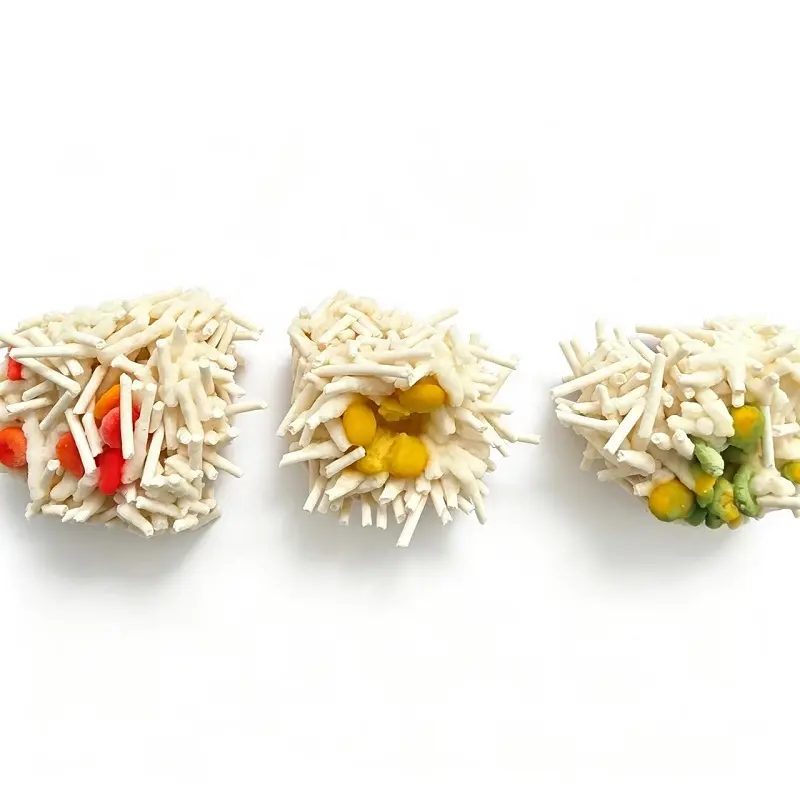
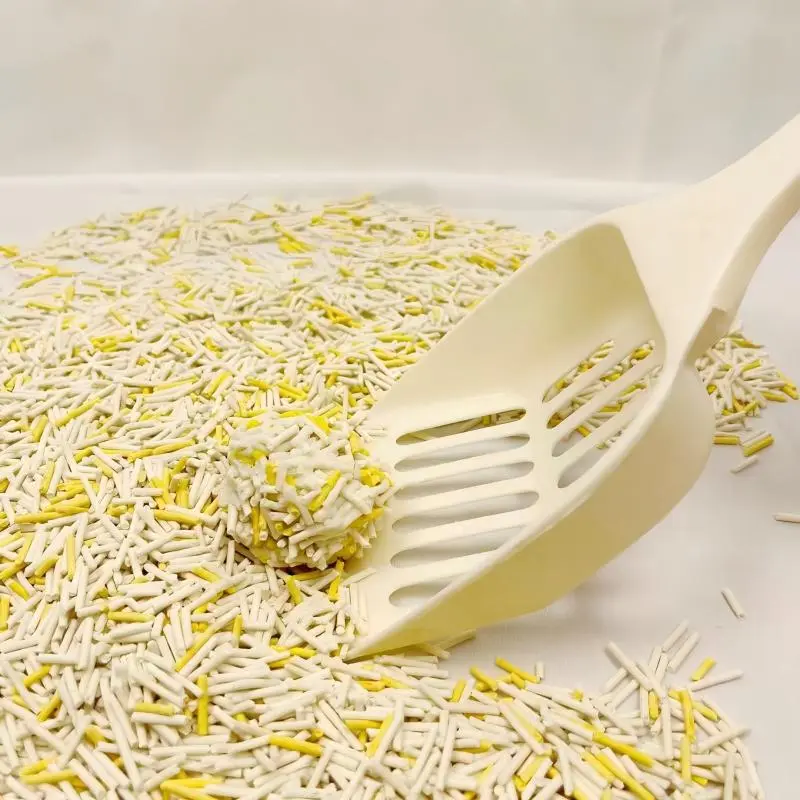
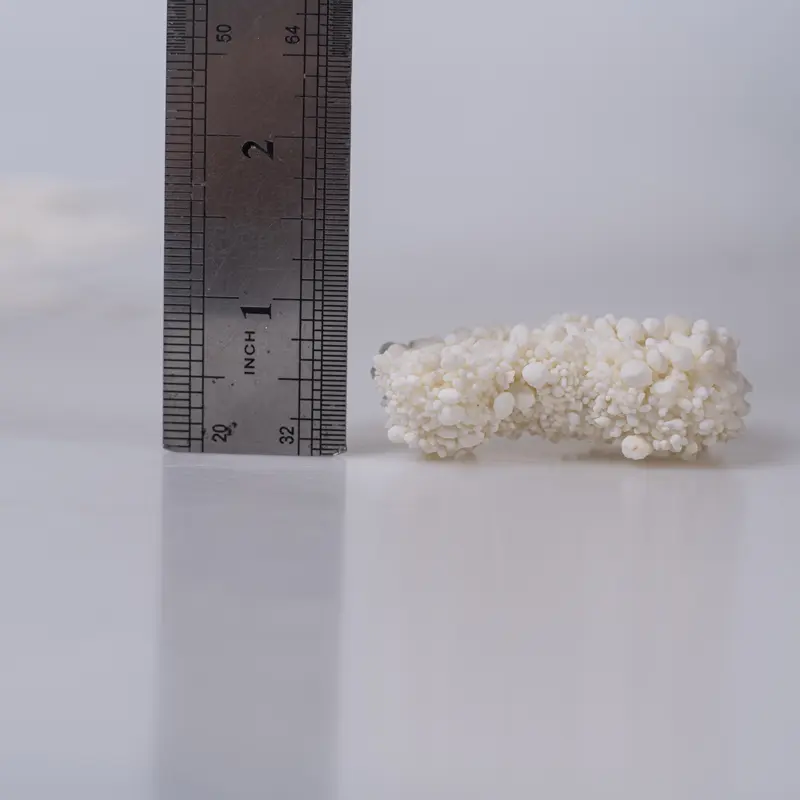
When a cat urinates in a clumping cassava litter, the starch-based material absorbs liquid and helps particles stick together. This allows owners to remove used litter with a scoop instead of replacing the entire box after every use.
The quality of clumping depends on several factors:
Cassava starch content.
Additional binding ingredients.
Granule size and structure.
Moisture content before use.
Liquid absorption speed.
The amount of litter used in the box.
Some cassava formulas produce firm clumps, while others may create softer clumps that break during scooping.
This is why it is important to test the actual product rather than assume that every cassava-based litter performs identically.
4. Potentially Lower Dust Than Some Traditional Clay Litters
Dust is an important consideration when choosing cat litter.
Fine particles can become airborne during pouring, digging, and scooping. Some cassava-based products are designed to reduce loose dust through granulation, drying, and screening.
However, low dust is not an automatic feature of every cassava product.
Dust levels may be affected by:
Raw-material particle size.
Granulation technology.
Drying conditions.
Screening and dust-removal equipment.
Packaging and transportation damage.
Storage conditions.
For buyers comparing suppliers, a measurable dust test is more useful than a general claim such as "dust-free."
A good supplier should be able to explain its dust-testing method and provide product-specific results. If respiratory sensitivity is a concern, consult a veterinarian about suitable litter options rather than relying on marketing descriptions alone.
5. A Different Texture for Cats That Prefer Fine Granules
Cat acceptance is an important part of litter selection.
Some cats prefer fine-grained litter because it feels closer to natural digging material. Other cats prefer larger granules or pellets.
Cassava cat litter can be produced in different particle sizes and shapes, depending on the manufacturing process.
This gives manufacturers flexibility to develop products for different consumer preferences.
Before switching completely, introduce a small quantity alongside the cat's existing litter. Observe whether the cat uses the new material comfortably.
A litter that performs well in a laboratory test is not necessarily a litter every cat will accept.
6. Potential for Different Product Formulations
Cassava starch can be used in different product formulations, allowing manufacturers to develop several product variations.
Depending on the target market, product development may involve:
Different particle sizes.
Different pellet shapes.
Natural or customized colors.
Unscented or fragranced formulas.
Cassava and corn starch combinations.
Different package sizes.
For example, a premium pet brand may prefer a fine-granule formula, while a mass-market retailer may prioritize package weight and cost efficiency.
Gelin Town Pet also offers other plant-based products, including corn cat litter and plant-based cat litter, allowing buyers to compare different raw materials when planning a product range.
7. Potentially Biodegradable Under Appropriate Conditions
Cassava starch is plant-derived and can be broken down by microorganisms under suitable conditions.
This makes cassava-based litter a potential alternative for consumers interested in biodegradable materials.
However, the finished product must be evaluated as a whole.
A formula containing cassava starch, synthetic additives, mineral ingredients, or other binders may behave differently from a simple starch-based formulation.
It is also important to distinguish between these terms:
| Environmental Term | What It Means |
|---|---|
| Renewable | The raw material can be replenished through agricultural production |
| Biodegradable | The material can be broken down by microorganisms under suitable conditions |
| Compostable | The product meets specific requirements for composting under defined conditions |
| Flushable | The product has been designed and tested for a particular wastewater disposal system |
These terms are not interchangeable.
Do not assume that a product is suitable for home composting or toilet disposal simply because it contains cassava starch.
6 Disadvantages of Cassava Cat Litter
Cassava litter has several useful features, but buyers should understand its limitations before making a purchase.
1. Higher Purchase Price Than Conventional Clay Litter
One common disadvantage is price.
Cassava cat litter may cost more than standard bentonite litter because of differences in raw-material sourcing, manufacturing, formulation, and product positioning.
The final retail price can also be affected by:
Brand positioning.
Packaging materials.
Import and distribution costs.
Order volume.
Product formulation.
Local competition.
For consumers, a higher purchase price may be worthwhile if the product provides the preferred handling and cleaning experience.
For wholesalers, the important question is not simply which litter has the lowest factory price. It is which product provides the best balance between selling price, product performance, and repeat-purchase potential.
2. Clumps May Not Be as Strong as Bentonite
Although cassava starch can help form clumps, not every cassava formula creates the same clump strength as sodium bentonite.
Bentonite is widely used because of its swelling and clumping properties. Some cassava products may produce softer clumps, particularly when the formulation or particle structure is not optimized.
Weak clumps can:
Break during scooping.
Leave small pieces in the litter box.
Increase cleaning time.
Require more frequent replacement.
The solution is not necessarily to reject cassava litter. Instead, compare actual clumping performance.
When testing samples, evaluate the clump immediately after formation and again after a short standing period. Check whether it remains intact when lifted with a scoop.
3. Fine Granules May Track Outside the Litter Box
Tracking occurs when litter particles stick to a cat's paws or fur and are carried outside the litter box.
Cassava litter can be produced in fine granules, and lightweight particles may be scattered during digging.
The amount of tracking depends on:
Granule size and shape.
Particle density.
Cat digging behavior.
Litter box design.
The type of floor around the box.
A larger-particle product may reduce some tracking issues, but it may not suit every cat.
Consider using a litter mat and a litter box with suitable side height. Test different granule sizes before choosing a product for long-term use.
4. Odor Control May Decline When the Litter Becomes Saturated
Cassava-based litter can absorb moisture, and its clumping structure may help remove urine from the litter box.
However, odor control is not determined by raw material alone.
It also depends on:
How quickly liquid is absorbed.
How effectively used litter forms removable clumps.
The amount of litter in the box.
Daily scooping frequency.
Ventilation and humidity.
Whether the product contains additional deodorizing ingredients.
When litter becomes saturated, its odor-control performance may decline.
For multi-cat households, frequent scooping and regular litter replacement are particularly important. A product that works well in a single-cat home may not provide the same experience in a busy multi-cat household.
5. Organic Materials Need Careful Storage
Plant-derived litter requires appropriate storage.
If unused litter is exposed to moisture or stored in a poorly ventilated environment, product quality may deteriorate. Organic materials can also be vulnerable to mold or insect problems under unsuitable storage conditions.
To help maintain product quality:
Store bags in a dry area.
Keep packaging sealed until use.
Avoid direct contact with wet floors.
Keep products away from leaking pipes and high-humidity areas.
Use opened bags within a reasonable period.
Inspect products for unusual odors, moisture, or visible contamination.
Retailers and distributors should also consider warehouse humidity, pallet protection, and container conditions during international transportation.
6. Not Every Cassava Product Is Flushable or Suitable for Composting
Some manufacturers market particular cassava formulas as flushable or compostable.
However, flushability depends on the finished product, the amount disposed of, plumbing conditions, and local wastewater regulations.
Even a plant-based litter should not automatically be flushed.
For example, the US Environmental Protection Agency advises septic-system owners not to flush cat litter into septic systems. Septic systems are designed primarily for human waste and toilet paper, not pet litter.
Composting also requires caution. Used cat litter may contain animal waste and pathogens. It should not be placed in a food garden or ordinary home compost system without checking local guidance and the specific product's suitability.
For further information, see our guide to disposing of cat litter correctly.
Cassava Cat Litter vs. Tofu Cat Litter vs. Bentonite Cat Litter
Cassava, tofu, and bentonite are different materials with different performance characteristics.
The best choice depends on what matters most to the household.
| Comparison Factor | Cassava Cat Litter | Tofu Cat Litter | Bentonite Cat Litter |
|---|---|---|---|
| Main material | Cassava-derived starch | Soybean or pea fiber, depending on formula | Natural clay |
| Raw-material source | Agricultural crop | Agricultural crop or by-products | Mined mineral |
| Typical form | Granules or pellets | Pellets or crushed particles | Fine granules |
| Clumping | Starch-based clumping | Fiber and binder-based clumping | Strong swelling-based clumping |
| Weight | Generally lightweight | Generally lightweight | Usually heavier |
| Dust | Depends on granulation and screening | Depends on granulation and screening | Varies by product |
| Tracking | Fine particles may track | Depends on pellet size and shape | Fine particles may scatter |
| Environmental profile | Plant-derived; disposal depends on formulation | Plant-derived; disposal depends on formulation | Mineral-based |
| Typical price position | Often premium to standard clay | Often premium to standard clay | Wide range, including budget options |
Cassava vs. Tofu Cat Litter
Cassava and tofu litter are both plant-based alternatives, but they use different primary materials.
Cassava litter relies mainly on starch-based binding, while tofu litter commonly uses soybean or pea fiber combined with binders.
Cassava may appeal to buyers seeking a starch-based formulation. Tofu litter offers a different range of pellet structures and product formats.
The actual performance depends on the formula and manufacturing process, not simply whether the product is made from cassava or tofu.
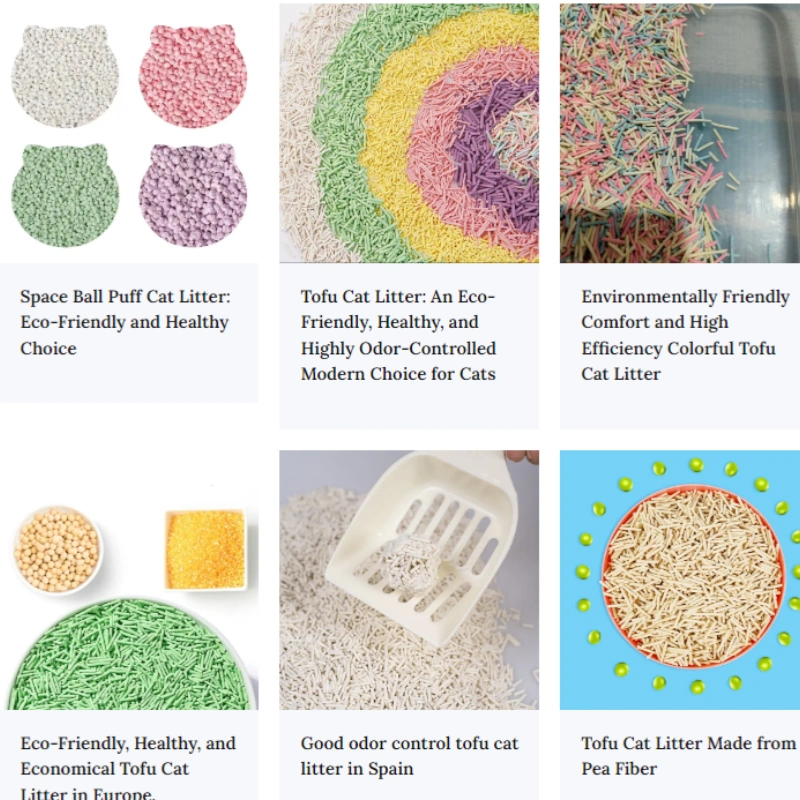
If you are comparing both materials for a product range, explore tofu cat litter products and compare samples under the same test conditions.
Cassava vs. Bentonite Cat Litter
Bentonite remains popular because of its familiar texture, strong clumping characteristics, and wide market availability.
Cassava litter offers a plant-derived alternative that is usually lighter to handle.
However, cassava litter may have a higher purchase price and may require more careful storage.
For buyers who prioritize raw-material origin and lightweight handling, cassava may be worth testing. For buyers prioritizing familiar clay performance and lower purchase cost, bentonite may remain the preferred choice.
Is Cassava Cat Litter Safe for Cats?
The safety of cassava cat litter depends on the quality of the raw materials, manufacturing process, final formulation, and how the product is used.
Cassava roots naturally contain cyanogenic compounds, so it is important to distinguish raw cassava from processed cassava starch used in manufactured products.
A responsible manufacturer should be able to explain:
The source and grade of the cassava raw material.
The processing method used.
Whether the final material is tested for relevant chemical residues.
The additives and binders included in the formula.
Moisture and microbiological quality controls.
Do not assume that every cassava-based litter is automatically safe to eat. Cat litter is not food, even when it contains food-derived ingredients.
Accidental ingestion of small amounts is different from repeated or substantial consumption. Large quantities of clumping litter may cause gastrointestinal problems or obstruction.
If a cat regularly eats litter, shows vomiting, reduced appetite, or unusual behavior, contact a veterinarian.
You can read more in our detailed guide: Is Cassava Cat Litter Safe?.
How to Choose Good-Quality Cassava Cat Litter
Not all cassava cat litter products have the same quality. Whether you are buying for home use or sourcing products for a retail brand, several factors deserve attention.
1. Check the Ingredient List
Start by understanding what the product actually contains.
Ask whether the main ingredient is cassava starch or whether the product combines cassava with corn starch, other plant fibers, or additional binders.
For B2B buyers, request an ingredient declaration and keep the approved formula on record.
2. Check Particle Size and Shape
Granule size affects the user experience.
Fine particles may provide a different texture from larger pellets. Particle shape and density can also influence tracking and handling.
If you are sourcing for a specific market, define the particle-size range before requesting quotations.
3. Evaluate Absorption and Clumping
A good sample evaluation should include:
Liquid absorption time.
Clump formation time.
Clump strength after formation.
Clump breakage during scooping.
Residual wet material in the litter box.
Use the same test conditions when comparing different manufacturers.
For a more reliable comparison, record the sample weight, liquid volume, waiting time, and testing method.
4. Ask for Dust Test Results
Do not rely only on descriptions such as low dust or dust-free.
Ask the supplier for the dust-testing method, measured results, and the product batch represented by the report.
Also check whether the sample has been transported and handled in the same way as commercial shipments.
5. Evaluate Packaging and Storage
Good packaging helps protect plant-based litter from moisture during storage and transportation.
Check:
Bag material and thickness.
Sealing quality.
Moisture protection.
Package weight and volume.
Label information.
Carton strength.
Pallet and container loading arrangements.
For international buyers, packaging performance is particularly important because products may spend weeks in transit.
Is Cassava Cat Litter Worth Trying?
Cassava cat litter can be a worthwhile option for households looking for plant-based litter with lightweight handling and starch-based clumping properties.
It may be especially attractive to buyers who value:
Renewable agricultural raw materials.
A lightweight alternative to mineral litter.
Plant-based product positioning.
Different particle sizes and product formulations.
However, it may not be the best option for every household.
If low purchase price is the main priority, conventional bentonite litter may be more economical. If a cat is sensitive to particular ingredients or strongly prefers another texture, a different litter type may be more suitable.
The most practical approach is to test a small quantity first, observe the cat's acceptance, and evaluate cleaning performance over several days.
For a broader comparison of plant-based materials, explore our guide to corn and cassava cat litter.
For Importers: What to Check When Buying Cassava Cat Litter Wholesale
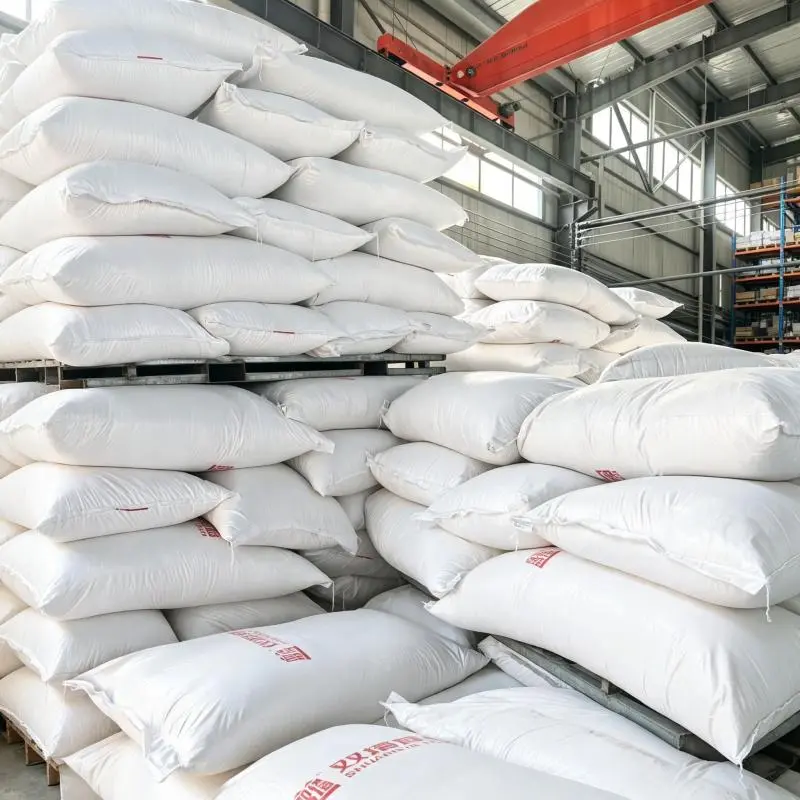
Cassava cat litter is also an opportunity for pet brands, distributors, wholesalers, and e-commerce sellers interested in developing plant-based product lines.
However, selecting a supplier requires more than finding a competitive price.
1. Confirm Manufacturing Capability
Ask whether the supplier operates its own factory or outsources production.
A real manufacturer should be able to explain its production process, including raw-material inspection, mixing, granulation, drying, screening, dust removal, and packaging.
If the supplier publishes an annual production capacity, ask whether that number represents all cat litter products or cassava litter specifically.
2. Confirm OEM and Private-Label Options
Depending on the manufacturer, customization may include:
Product formulation.
Particle size and shape.
Product color.
Fragrance.
Bag size and packaging material.
Private-label artwork.
Carton and pallet specifications.
Gelin Town Pet provides cassava cat litter OEM and private-label manufacturing for buyers developing their own product lines.
3. Compare MOQ and Packaging
Minimum order quantities vary according to formula, packaging, and production requirements.
For example, Gelin Town's published cassava product information lists 6 L/2.5 kg, 7 L/2.8 kg, and 10 L/4.5 kg packaging examples, as well as customized packaging options. Its listed MOQ is one 20-foot container for the referenced product, subject to confirmation for the required specification.
Before ordering, confirm the current MOQ, bag design requirements, container loading quantity, and delivery terms.
4. Request Samples and Batch Documentation
Before approving bulk production, request samples and a current technical data sheet.
Important quality indicators include:
| Quality Item | What to Verify |
|---|---|
| Raw material | Ingredient declaration and raw-material source |
| Moisture | Product moisture specification |
| Absorption | Test method and measured absorption performance |
| Clumping | Formation time and clump strength |
| Dust | Testing method and measured dust content |
| Appearance | Particle size, color, and shape consistency |
| Packaging | Sealing strength and moisture protection |
| Microbiological quality | Relevant test reports and applicable limits |
A test report should identify the sample, test date, method, and laboratory where applicable. Do not assume that a certificate covering a company's management system automatically verifies every product specification.
5. Work with a Manufacturer That Supports Long-Term Supply
A successful private-label project requires repeatable product quality.
The supplier should be able to maintain the approved formula, packaging specification, and quality standards across different production batches.
Gelin Town Pet is a plant-based cat litter manufacturer established in 2020. According to its published company information, the company operates a production area of approximately 16,000 square meters and reports an annual production capacity of 7,000 tons across its cat litter business.
Its product portfolio includes cassava, tofu, corn, cereal, mixed, and other plant-based cat litter products. The company provides wholesale, OEM, ODM, and private-label services.
You can learn more about the Gelin Town Pet factory and its manufacturing background before discussing your product requirements.
Frequently Asked Questions About Cassava Cat Litter
1. What are the main advantages of cassava cat litter?
The main advantages include plant-derived raw materials, lightweight handling, starch-based clumping, and the potential for relatively low dust when properly manufactured. It also provides another option for consumers who prefer plant-based cat litter.
2. What are the disadvantages of cassava cat litter?
Common disadvantages include a higher purchase price than standard clay litter, possible tracking, variable clump strength, moisture-sensitive storage, and the need for more frequent cleaning in some households.
3. Does cassava cat litter clump well?
Cassava starch can help bind particles together when exposed to moisture. However, clumping strength depends on the formula, granule structure, and manufacturing process. Some products may form stronger clumps than others.
4. Is cassava cat litter better than bentonite?
Neither material is universally better. Cassava is a plant-based alternative that is generally lighter, while bentonite is known for strong clumping and broad market availability. The best choice depends on budget, cleaning preferences, product performance, and environmental priorities.
5. Does cassava cat litter produce dust?
Dust levels vary by manufacturer and product. Proper granulation, drying, screening, and dust removal can help reduce loose particles. Buyers should request product-specific test results instead of relying on a general dust-free claim.
6. Does cassava cat litter control odor?
Cassava litter can absorb moisture and form clumps that are easier to remove. However, odor control depends on the formula, saturation level, litter-box maintenance, and cleaning frequency. Daily scooping remains important.
7. Can cassava cat litter be flushed down the toilet?
Not every cassava cat litter product is flushable. Even products marketed as flushable may not be suitable for every plumbing or wastewater system. Follow the manufacturer's tested disposal instructions and local regulations. Do not flush cat litter into septic systems.
8. Is cassava cat litter biodegradable?
Cassava starch is plant-derived and can biodegrade under suitable conditions. However, the finished litter's biodegradability depends on its complete formulation and disposal environment. Check the product documentation before making composting or environmental claims.
9. Can cassava cat litter grow mold?
Plant-derived litter can be affected by moisture and unsuitable storage conditions. Keep unused litter sealed and store it in a dry environment. Remove wet and soiled litter regularly, and inspect products for visible contamination or unusual odors.
10. Is cassava cat litter suitable for kittens?
It depends on the kitten's behavior, age, and tendency to chew or swallow litter. Kittens may explore unfamiliar materials by mouthing them. Choose a suitable product, supervise the transition, and consult a veterinarian if a kitten repeatedly eats litter.
11. How often should cassava cat litter be changed?
Remove solid waste and urine clumps regularly according to the product instructions and household conditions. Replace the full litter-box contents when the litter becomes saturated, develops persistent odor, or no longer performs effectively. Multi-cat households may need more frequent maintenance.
12. Can cassava cat litter be customized for private-label brands?
Many manufacturers offer OEM and private-label services. Customization may include particle size, formula, color, fragrance, bag size, and packaging design. Buyers should confirm the MOQ and technical requirements for each customized option.
Final Verdict: Are the Pros of Cassava Cat Litter Worth the Cons?
Cassava cat litter offers several useful features, particularly for consumers who want a lightweight, plant-derived alternative to traditional mineral litter.
Its starch-based clumping properties, renewable raw-material source, and potential for low-dust formulations make it an interesting option for modern pet product development.
However, it also has limitations. Price, tracking, clump strength, odor control, and moisture management should all be considered before making a purchase.
For cat owners, the best way to evaluate cassava litter is to test a small amount and observe how the cat responds.
For importers and private-label brands, the most important factors are raw-material transparency, product testing, manufacturing consistency, packaging quality, and reliable supply.
If you are looking for a cassava cat litter manufacturer in China, Gelin Town Pet can help you evaluate product specifications, packaging options, and OEM/ODM requirements.
Contact Gelin Town Pet to discuss your target market and cassava cat litter sourcing plans.