When choosing a plant-based cat litter, two options that increasingly attract attention are rice cat litter and tofu cat litter. Both are positioned as alternatives to traditional clay litter, but they are not identical. Their raw materials, particle structure, absorption behavior, clumping performance, odor control and user experience can differ significantly.
So, which is better: rice cat litter or tofu cat litter?
The answer depends on what matters most to you. If you prioritize fast clumping and lightweight handling, tofu cat litter may have an advantage. If you are looking for a rice-based, plant-derived alternative with a different texture and absorption profile, rice cat litter may be worth considering.
This guide compares rice cat litter vs tofu cat litter from the perspective of the factors that matter most to cat owners, retailers and private-label buyers.
What Is Rice Cat Litter?
Rice cat litter is a plant-based cat litter made from rice-derived materials, such as rice husk, rice bran, rice starch or other processed rice by-products, depending on the manufacturer's formulation.
The raw materials are processed into pellets or granules designed to absorb urine and control moisture inside the litter box.
Different rice cat litter products can have very different characteristics. Some are non-clumping absorbent litters, while others are formulated with plant-based binders to produce clumps.
The key point is that “rice cat litter” describes the primary raw material, not one standardized product formula.
This means buyers should evaluate the actual absorption, dust, odor control and clumping performance instead of assuming that every rice litter performs the same way.
What Is Tofu Cat Litter?
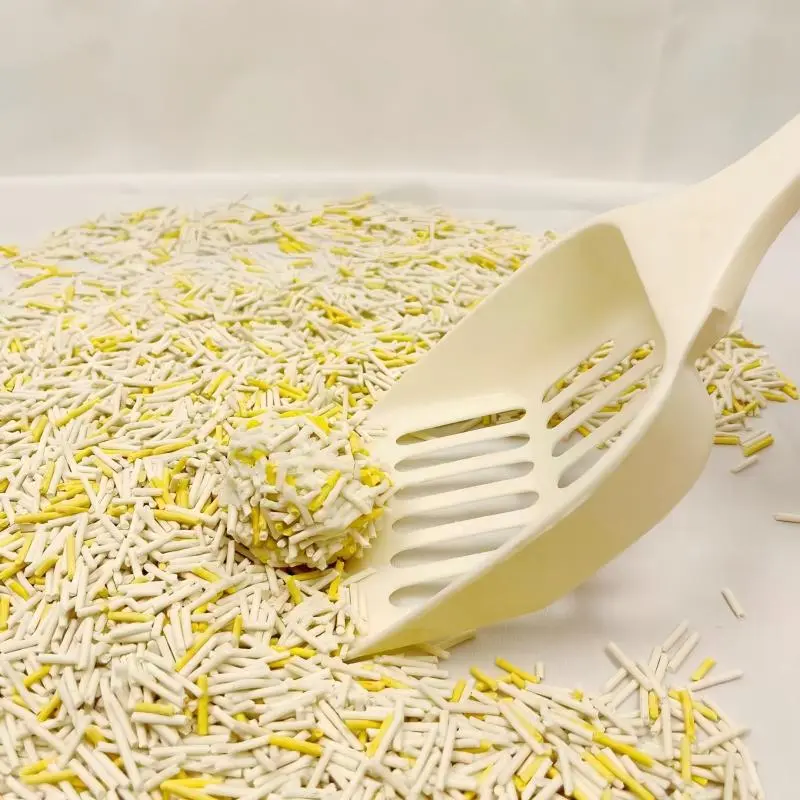
Tofu cat litter is another plant-based litter, usually manufactured using soybean fiber or soybean-derived materials.
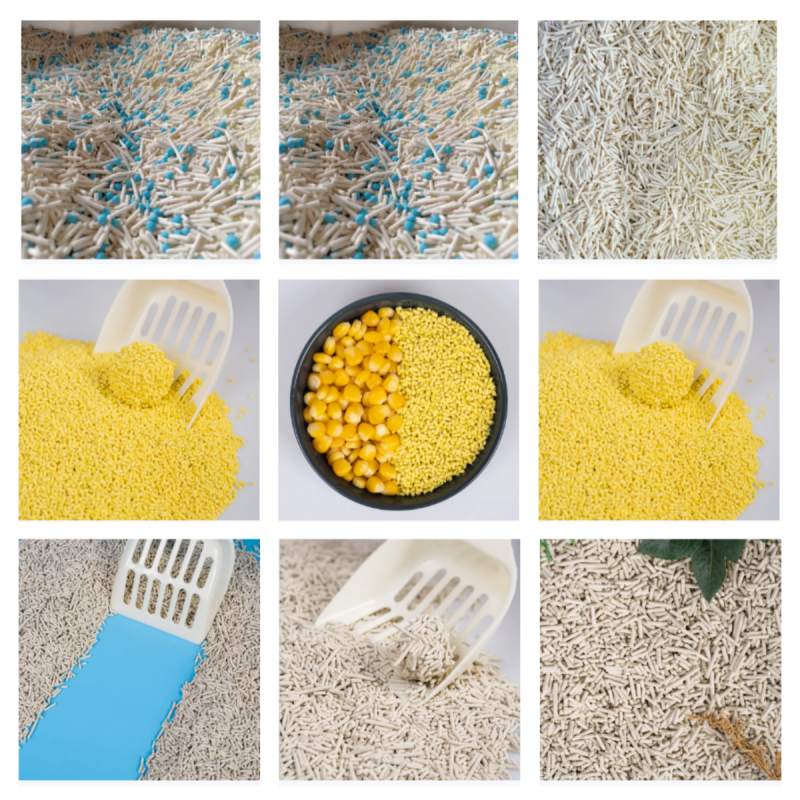
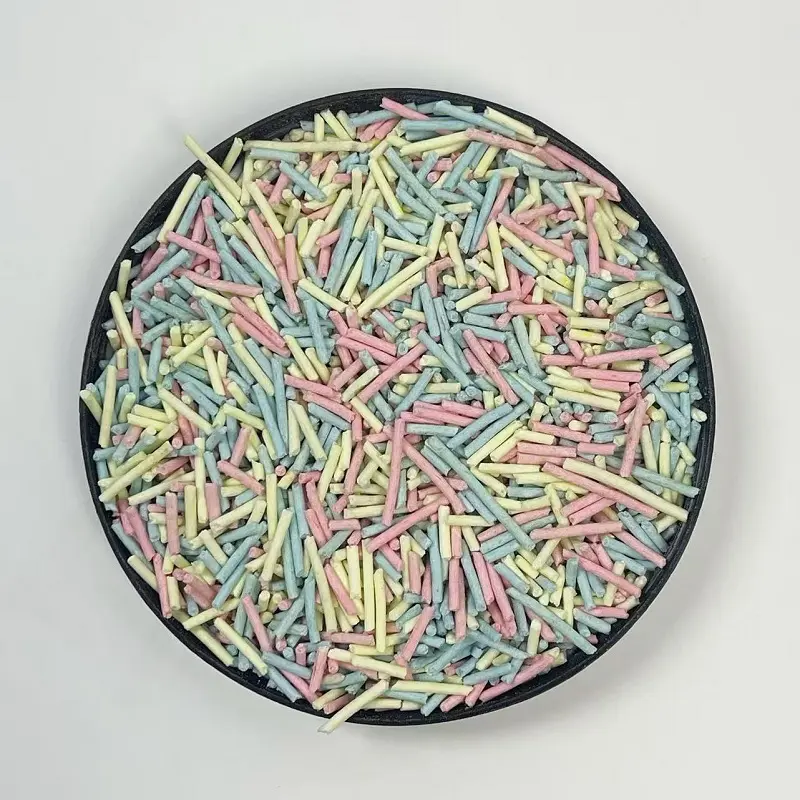
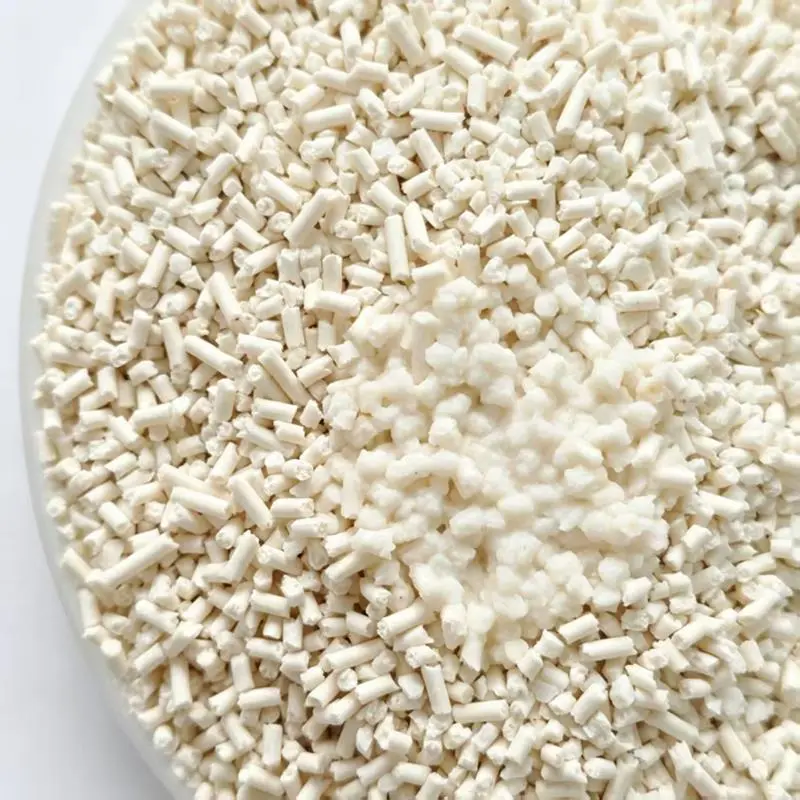
Tofu litter is commonly produced as cylindrical pellets, short granules or finer particles. Many products are formulated as clumping litter, allowing cat owners to remove urine-soaked material with a scoop.
A typical tofu cat litter may contain soybean fiber combined with ingredients such as plant starch or natural binders. Some products also include activated carbon or other odor-control components.
Tofu litter has become particularly popular in the premium plant-based litter category because it can combine:
Fast absorption
Strong clumping
Low dust
Lightweight handling
Odor control
Plant-based positioning
However, quality varies between manufacturers and formulas.
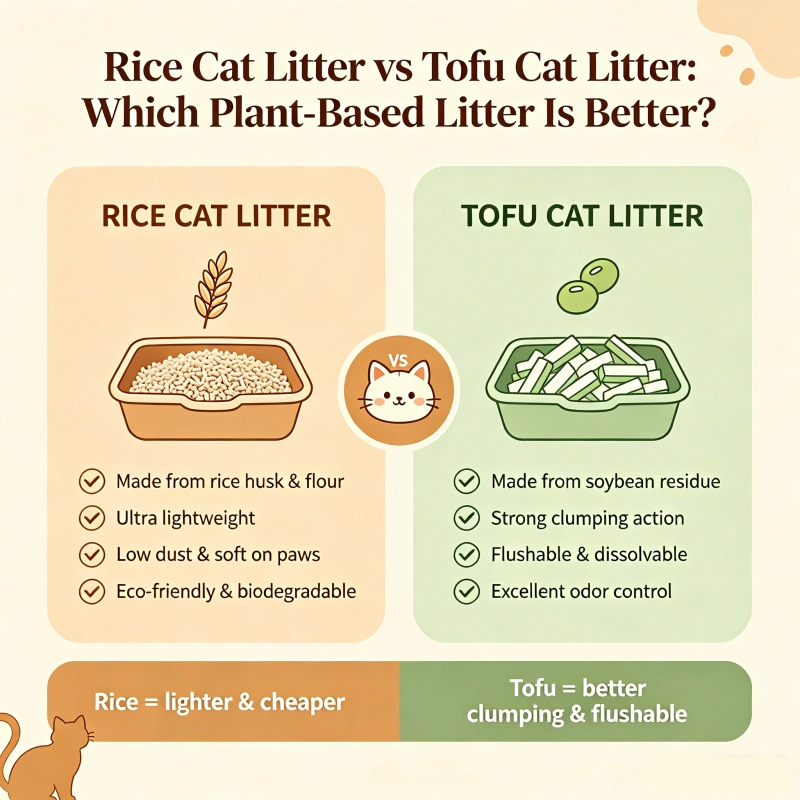
Rice Cat Litter vs Tofu Cat Litter: Quick Comparison
| Feature | Rice Cat Litter | Tofu Cat Litter |
|---|---|---|
| Main material | Rice-derived plant materials | Soybean-derived plant fiber |
| Plant-based | Yes | Yes |
| Absorption | Good to excellent, formula dependent | Good to excellent |
| Clumping | Depends on formulation | Commonly available |
| Odor control | Good, formula dependent | Good to excellent |
| Dust | Can be low | Usually low in optimized products |
| Weight | Generally lightweight | Lightweight |
| Tracking | Depends on particle size | Low to moderate |
| Texture | Varies | Pellet or fine granule |
| Premium positioning | Growing | Strong |
| Automatic litter-box compatibility | Product dependent | Product dependent |
The table provides a general comparison. Actual performance depends on raw materials, processing technology and formulation.
Which Has Better Absorption?
Absorption is one of the first things cat owners should compare.
Rice Cat Litter Absorption
Rice-derived materials can absorb moisture effectively when appropriately processed. The performance depends on the structure and density of the particles.
Rice husk-based products, for example, can behave differently from rice-starch-based granules.
For non-clumping products, the main objective is to capture urine and keep the litter box relatively dry.
Tofu Cat Litter Absorption
Tofu cat litter can provide fast liquid absorption because soybean fiber has a porous plant structure. Fine or optimized particles can create a large contact area with liquid.
Many tofu formulations are specifically designed for rapid absorption followed by clumping.
Winner: Tofu for Clumping Applications
There is no universal winner in absorption because formulations differ, but tofu cat litter often has an advantage when fast absorption and clumping are combined into one product.
Rice litter can still provide excellent absorption when properly engineered.
Which Has Better Clumping?
Clumping is a major difference to consider.
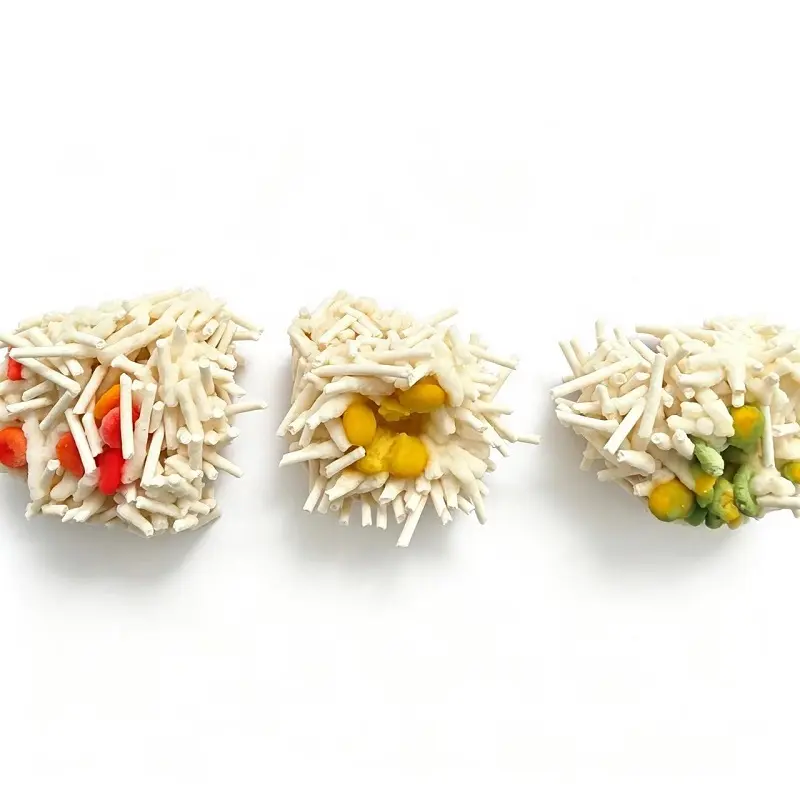
Tofu cat litter is widely available in clumping formulations. When urine contacts the pellets, the plant-based material absorbs moisture and forms a compact mass.
Good clumping provides several advantages:
Easier daily cleaning
Less clean litter wasted
Better urine removal
Cleaner litter-box bottom
Potentially longer usable life
Rice cat litter can also be manufactured as a clumping product, but not every rice-based litter is designed this way.
Winner: Tofu Cat Litter
If your priority is strong, fast and convenient clumping, tofu generally has the advantage because clumping is a central feature of many commercial tofu-litter formulations.
Which Controls Odor Better?
Odor control depends on more than the raw material.
The main source of litter-box odor is urine and fecal waste. Rapid absorption can reduce the amount of liquid exposed to air, while removing clumps regularly prevents waste from remaining in the box.
Tofu cat litter can provide good odor control through:
Fast moisture absorption
Clump formation
Odor adsorption
Activated carbon
Deodorizing ingredients
Rice cat litter can also provide odor control, particularly when the formulation includes effective absorbent or deodorizing components.
Therefore, comparing “rice” and “tofu” alone is not enough.
Winner: Depends on Formulation
For both products, the best odor control comes from the combination of absorption + moisture isolation + waste removal + deodorizing technology.
Which Produces Less Dust?
Dust is particularly important for indoor cats.
Very fine particles can become airborne when litter is poured, scooped or disturbed. Manufacturers can reduce dust through particle-size control, screening and dedusting processes.
Tofu litter is commonly available in low-dust formulations, although very fine tofu granules can still produce dust if manufacturing quality is poor.
Rice litter can also be manufactured with low-dust characteristics, but the result depends heavily on the raw material and processing method.
Rather than trusting the product name, buyers should look for actual dust-control specifications or test results.
Winner: Tie
Both can provide low-dust performance when properly manufactured.
Which Has Better Odor-Control Performance in Multi-Cat Homes?
Multi-cat households create a much higher waste load than single-cat homes.
In this environment, the litter needs:
Fast urine absorption
Strong clumping
Effective odor control
Easy daily scooping
Good moisture retention
Tofu litter is often attractive for multi-cat households because clumping allows contaminated material to be removed quickly.
Rice litter can also work effectively, particularly when formulated specifically for multi-cat applications.
Winner: Tofu for Clumping-Based Systems
Tofu generally has a practical advantage when the goal is to combine odor control with frequent scoop-and-remove maintenance.
Which Is Better for Kittens?
Kittens can be more curious about new litter and may investigate or taste unfamiliar particles.
For kittens, the most important characteristics are not simply whether the litter is made from rice or tofu.
Consider:
Low dust
Appropriate particle size
Minimal unnecessary fragrance
Clear ingredient information
Good manufacturing hygiene
Easy monitoring of litter-box habits
If a kitten repeatedly eats litter, the owner should address the behavior and consult a veterinarian if necessary.
Neither rice nor tofu litter should be considered food simply because it is plant-based.
Which Is Better for Automatic Litter Boxes?
Automatic litter boxes can be sensitive to litter characteristics.
The most important factors include:
Particle size
Granule density
Clump formation speed
Clump hardness
Moisture content
Screening behavior
Tofu litter is available in formulations specifically designed for automatic litter boxes, but compatibility varies between machines.
Rice litter can also be compatible with some systems.
However, manufacturers should avoid claiming universal compatibility.
Winner: Product Dependent
For automatic litter boxes, the specific formulation matters more than whether the litter is made from rice or tofu.
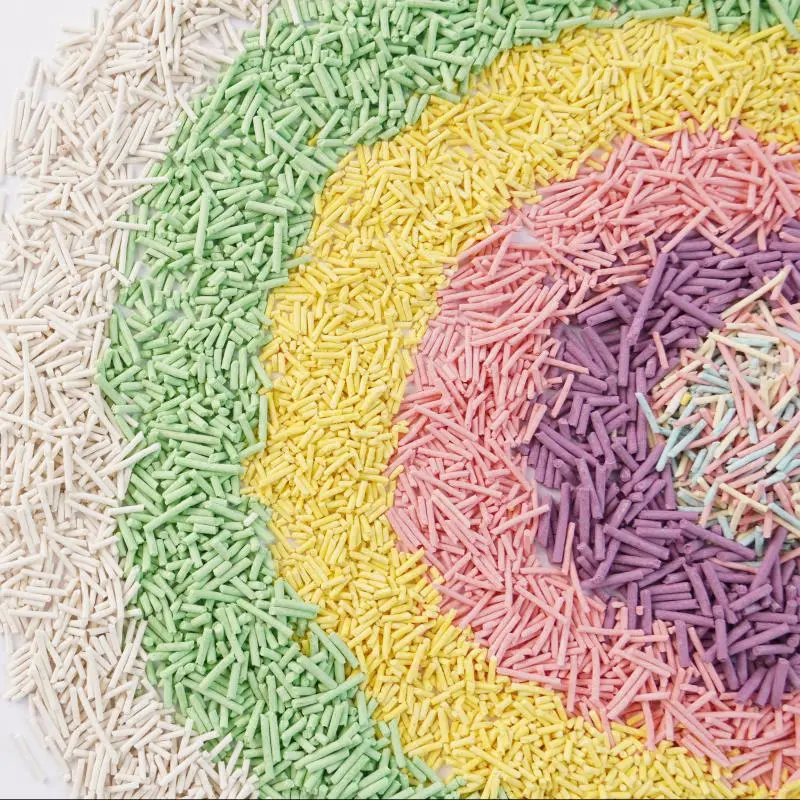
Rice Cat Litter vs Tofu Cat Litter for Tracking
Tracking occurs when litter particles stick to a cat's paws and are carried away from the litter box.
Very fine particles can increase tracking, while large pellets may reduce tracking but potentially affect a cat's preference.
Tofu litter is available in different particle sizes, including larger pellets and smaller granules.
Rice litter also varies significantly in particle structure.
A good product should balance:
Absorption + cat comfort + low tracking.
Winner: Depends on Particle Design
There is no reliable winner based only on the raw material.
Which Is More Environmentally Friendly?
Both rice and tofu litter have strong plant-based positioning.
Rice litter may use rice-derived agricultural materials or processing by-products. Tofu litter uses soybean-derived materials.
This gives both categories an alternative to mineral clay.
However, consumers should be careful with environmental claims.
“Plant-based” does not automatically mean:
Completely biodegradable
Carbon neutral
Compostable everywhere
Safe to flush
Environmentally impact-free
The environmental profile depends on raw-material sourcing, manufacturing, packaging, transportation and disposal.
Winner: Depends on Product Lifecycle
Rice and tofu can both support plant-based product positioning. Brands should use specific, evidence-based environmental claims rather than broad statements.
Is Rice Cat Litter or Tofu Cat Litter Safer?
Neither category should automatically be described as universally safer.
Safety depends on the finished product.
Important factors include:
Ingredient quality
Dust level
Additives
Fragrance
Manufacturing hygiene
Particle size
Packaging
Storage conditions
A high-quality tofu litter may be preferable to a poorly manufactured rice litter, and vice versa.
The safest purchasing approach is to evaluate the finished product rather than the marketing category.
Which Is Easier to Clean?
Tofu cat litter generally has an advantage because many tofu products are designed as clumping litter.
When urine creates a firm clump, the owner can remove the contaminated material without replacing all of the clean litter.
Rice litter can provide the same experience if it is specifically formulated as clumping litter.
For non-clumping rice litter, users may need to replace larger quantities of litter more frequently.
Winner: Tofu Cat Litter
For convenient scoop-and-clean maintenance, tofu usually has the advantage.
Rice Cat Litter vs Tofu Cat Litter: Price
Price varies considerably according to raw materials, production technology, packaging, transportation and brand positioning.
Traditional clay litter is often highly competitive on price because of its mature production and distribution network.
Plant-based litters such as rice and tofu are frequently positioned in the premium segment.
Tofu litter may have a higher retail price than basic clay litter, but its lightweight structure and clumping efficiency can influence the overall cost per day.
For B2B buyers, the more useful calculation is not simply price per bag.
Instead, compare:
Cost per usable day = purchase price ÷ estimated days of effective use.
This provides a better comparison between different litter types.
Which Is Better for Different Cat Owners?
Choose Tofu Cat Litter If You Prioritize:
Strong clumping
Fast absorption
Easy daily scooping
Low dust
Odor control
Lightweight handling
Premium plant-based positioning
Tofu is particularly attractive for indoor cats and multi-cat households.
Choose Rice Cat Litter If You Prioritize:
Rice-derived plant materials
An alternative plant-based material
Different pellet or granule textures
Lightweight handling
A differentiated product concept
Rice litter can also be an interesting choice for brands developing specialized plant-based litter products.
What Should Pet Brands Consider?
For distributors and private-label brands, the choice between rice and tofu is also a commercial decision.
Tofu cat litter currently has a strong consumer recognition within the plant-based category. It can be marketed around:
High absorption
Clumping
Odor control
Low dust
Plant-based ingredients
Rice cat litter can provide greater differentiation where brands want to introduce a less conventional plant-based material.
For either product, buyers should evaluate:
Raw material quality
Absorption rate
Clumping strength
Dust level
Particle-size distribution
Tracking
Odor-control performance
Packaging
Shelf stability
Batch consistency
OEM/private-label capability
A professional manufacturer should be able to provide product specifications and samples for evaluation before a commercial order.
Frequently Asked Questions
Is tofu cat litter better than rice cat litter?
Not necessarily. Tofu generally has an advantage in clumping and convenient daily cleaning, while rice litter can provide a different plant-based option. The best choice depends on the specific formulation and the owner's priorities.
Does rice cat litter clump?
Some rice cat litter products are designed to clump, while others are non-clumping absorbent products. Always check the manufacturer's product specifications.
Does tofu cat litter control odor?
Yes, a well-formulated tofu cat litter can provide good odor control through rapid moisture absorption, clumping and, in some formulas, additional odor-adsorbing ingredients.
Is tofu cat litter low dust?
Many tofu products are designed to be low dust, but not every product performs equally. Particle size and manufacturing quality have a major impact.
Can rice or tofu cat litter be flushed?
Some plant-based products are marketed as flushable, but flushability depends on the specific formulation and local wastewater requirements. Consumers should follow the manufacturer's disposal instructions and local regulations.
Which is better for multiple cats?
Tofu cat litter can be particularly convenient for multi-cat homes because many formulations provide strong clumping and easy waste removal. A high-quality rice clumping litter can also work well.
Final Verdict: Rice Cat Litter or Tofu Cat Litter?
So, which is better in the rice cat litter vs tofu cat litter comparison?
For most consumers looking for high absorption, strong clumping, easy cleaning, low dust and odor control, tofu cat litter is likely to be the more practical choice.
Rice cat litter remains an interesting plant-based alternative, particularly for consumers and brands looking for rice-derived materials and a differentiated product concept.
The most important lesson is that raw material does not determine product quality by itself. A well-engineered litter needs the right particle size, absorption structure, clumping technology and dust-control process.
For cat owners, the best choice is the litter that their cat accepts and that performs reliably in the home. For retailers and private-label brands, the best choice is the product that combines consistent manufacturing quality with a clear market position.
In short:
Tofu cat litter wins on clumping and convenient daily cleaning, while rice cat litter offers another promising plant-based option.
The final decision should be based on absorption, odor control, dust, tracking, clumping, cat acceptance and total cost of use—not simply the name of the raw material.
387.webp)