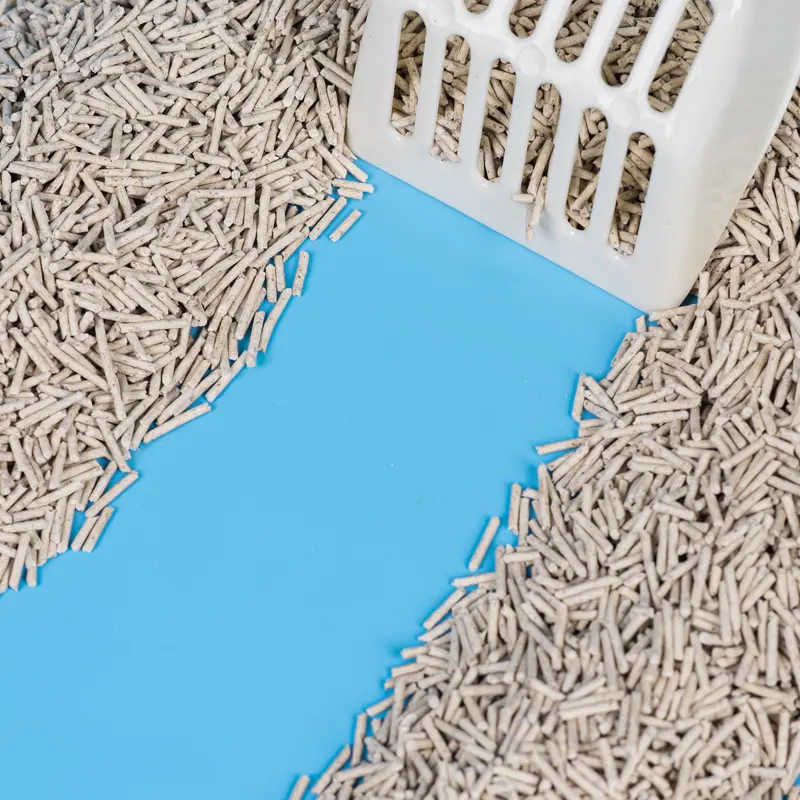
Eco-friendly peanut shell cat litter is an alternative to conventional mineral-based litter that uses processed peanut shells as a major raw material. By recovering an agricultural by-product and combining it with other plant-derived ingredients, manufacturers can develop cat litter products designed for liquid absorption, clumping, and convenient daily cleaning.
For European pet product businesses, this type of litter may offer an opportunity to expand a plant-based product range and differentiate a private-label brand. However, a promising product concept is not automatically a proven commercial success. Retailers and importers need to evaluate customer demand, finished-product performance, landed cost, environmental claims, and disposal requirements before committing to a new product line.
This guide explains how peanut shell cat litter works, its potential advantages and limitations, the specifications buyers should check, and how to decide whether it fits your business strategy.
What Is Peanut Shell Cat Litter?
Peanut shell cat litter is made using processed peanut shells, the outer husks left after peanuts are harvested and processed. Instead of treating these shells only as agricultural residue, manufacturers can recover and process them into a raw material for other applications.
Gelin Town Pet's peanut shell cat litter combines the following listed ingredients:
Peanut shells: The main recycled or recovered agricultural by-product in the formulation.
Pea fibre: A plant-derived ingredient that contributes to the material structure.
Corn starch: Can support binding and pellet formation during processing.
Guar gum: A binder and thickening agent that can contribute to clumping behavior.
The exact function of each ingredient depends on the formulation, processing conditions, and its interaction with the other components.
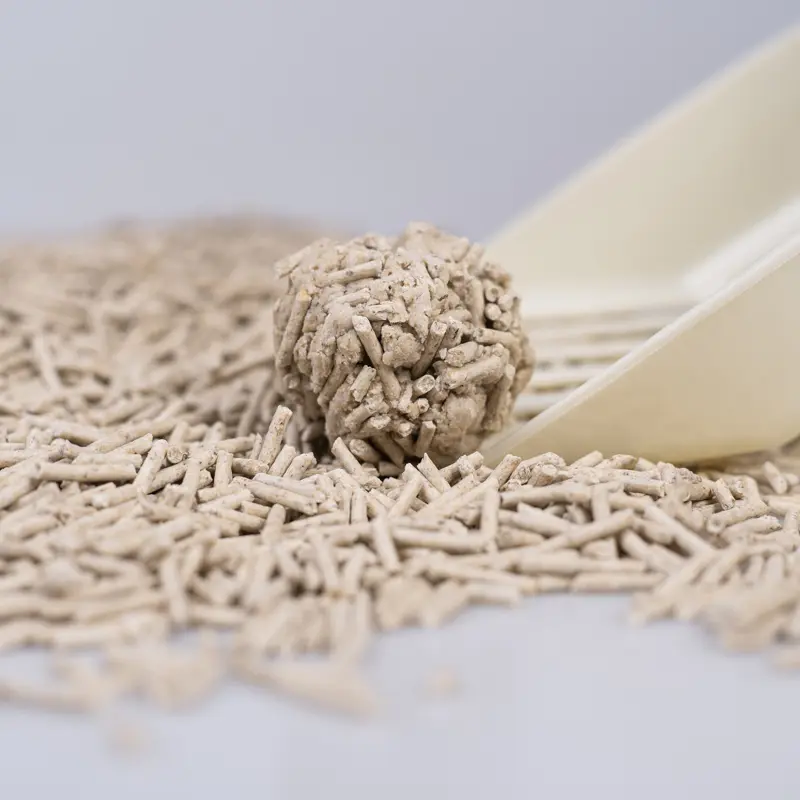
The finished product is designed as a clumping cat litter in a cylindrical granule format. According to the manufacturer's listing, it is intended to absorb liquid and form removable clumps during normal use.
An important distinction is that using a recycled agricultural by-product does not automatically make the entire product fully recycled, compostable, or environmentally superior in every respect. Buyers should establish which ingredients are recovered materials and what evidence supports the product's environmental claims
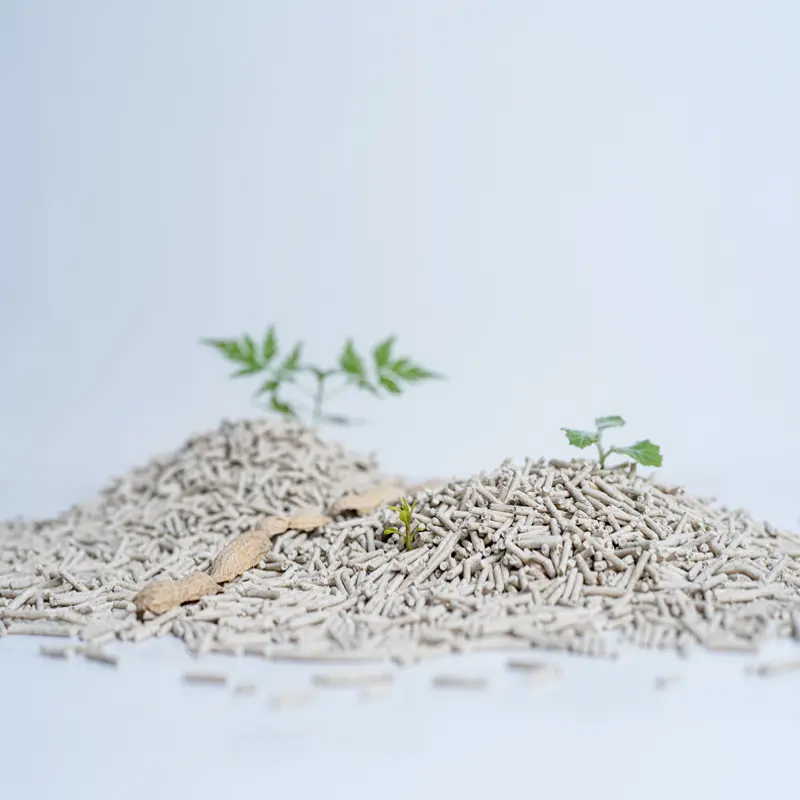
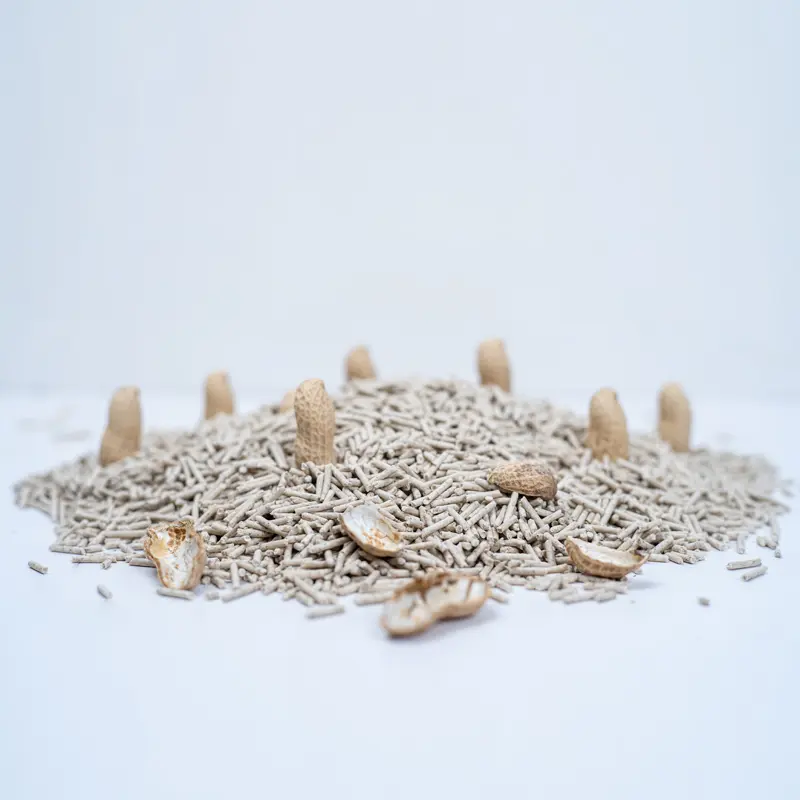
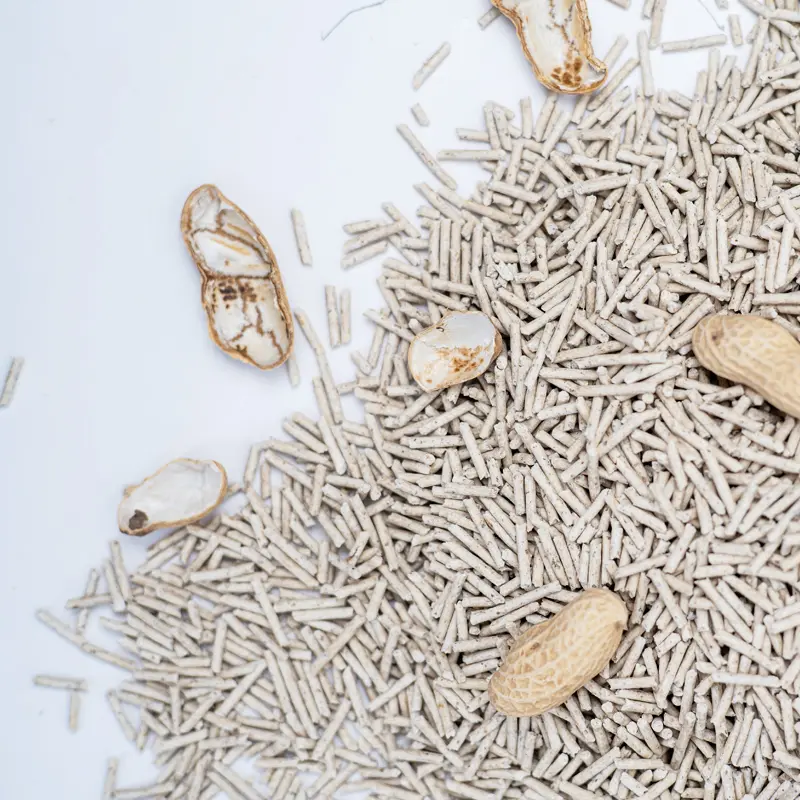
"This picture showed that the peanut shell is a main material.The column shape pellets will give the cat's a comfortable foot feels and it will be not easy to be brought out of litter box"
Why Consider Peanut Shell Cat Litter for the European Market?
Europe represents a substantial market for pet products. FEDIAF's 2026 Facts & Figures report, based on 2024 data, covers 41 European countries and reports approximately 140 million pet-owning households, representing 49% of households in the covered region.
This provides useful market context, but it does not establish the sales volume, market share, or growth rate of peanut shell cat litter specifically. Businesses should validate actual demand through customer research, retailer discussions, product trials, and sales data.
For companies developing a plant-based cat litter range, peanut shell litter has several potential points of differentiation.
1. Using an agricultural by-product
A major selling point is the use of peanut shells that would otherwise have a different, lower-value use or potentially become waste.
This can support a circular-materials product story when the raw material is genuinely recovered and its origin is traceable. It may also allow brands to explain how agricultural processing by-products can be used in a new product category.
For a credible sustainability message, buyers should ask the supplier:
Where do the peanut shells come from?
Are they recovered from an agricultural processing stream?
How are they cleaned, dried, and processed?
What proportion of the final formula is peanut shell material?
What other materials and additives are included?
Is there documentation supporting the claimed environmental benefit?
These questions help distinguish a specific material-recovery story from a vague claim that a product is simply “green.”
2. Differentiation from established litter materials
Most buyers already understand categories such as clumping clay, corn, tofu, and silica litter. Peanut shell litter introduces another plant-derived option.
This can be useful for retailers that want a differentiated product rather than another standard version of an established category.
However, differentiation alone does not guarantee sales. Customers must still find the product easy to use, acceptable to their cats, competitively priced, and readily available.
3. Potential for a distinctive private-label story
For pet brands, peanut shell litter may support positioning around recovered agricultural materials, plant-derived ingredients, and practical waste reduction.
The strongest brand proposition combines this material story with measurable product performance.
For example, a product page can explain the source of its raw materials and provide tested information about absorption, clump integrity, dust, and packaging. That is more useful than relying only on broad environmental language.
4. Multiple packaging options
Gelin Town Pet lists 6L/2.5kg, 7L/2.8kg, and 10L/4.5kg packaging options, with customized packaging available upon order confirmation.
These formats may support different retail positions. Smaller packages can be useful for trial purchases, while larger bags may suit consumers who have already adopted the product.
The right assortment depends on the target retail price, shipping cost, shelf space, customer purchasing habits, and expected sales volume.
Peanut Shell Cat Litter Product Specifications
Gelin Town Pet publishes the following specifications for its peanut shell cat litter.
| Specification | Manufacturer-listed information |
|---|---|
| Main materials | Peanut shell, pea fibre, corn starch, guar gum |
| Granule diameter | Approximately 2 mm |
| Granule format | Cylindrical pellets |
| Bulk density | 650–700 g/L |
| Moisture content | ≤10% |
| Absorption rate | ≥350% |
| Clumping | Listed as clumping |
| Dust | Described by the manufacturer as low-dust |
| Tracking | Described by the manufacturer as reduced tracking |
| Fragrance | Listed as natural |
| Biodegradability | Claimed by the manufacturer |
| Flushability | Claimed by the manufacturer |
| Available packaging | 6L/2.5kg, 7L/2.8kg, 10L/4.5kg, or customized |
| OEM/private label | Available according to the product listing |
| Listed minimum order quantity | 1 × 20-foot container |
| Listed payment terms | T/T |
| Country of origin | China |
These are manufacturer-published specifications and claims, not independently verified test results. In particular, the public listing does not provide a detailed absorption test method or quantitative results supporting every environmental and performance claim.
Before using these figures to compare suppliers or prepare European retail packaging, request the current technical data sheet and supporting documentation.
What does an absorption rate of 350% mean?
An absorption figure is useful only when the measurement method is known.
For example, an absorption rate expressed as a percentage by weight may be calculated as:
Absorption rate (%) = (Liquid absorbed ÷ Initial dry sample weight) × 100
Under this example, a 10 g sample that absorbs 35 g of liquid would produce a calculated absorption rate of 350%.
This calculation explains one common way to express absorption; it does not confirm that the manufacturer's published result was obtained using this exact method. Buyers should request the test liquid, exposure time, sample preparation method, and calculation procedure before comparing absorption figures across suppliers.
What Are the Main Advantages of Peanut Shell Cat Litter?
1. A plant-derived material base
Peanut shell litter offers an alternative to conventional mineral-based materials. For consumers who want to explore plant-derived litter, this provides another product option.
However, plant-derived materials are not automatically safe to ingest, dust-free, or suitable for every cat. The complete formulation and product instructions still matter.
2. Potential for convenient clumping
Gelin Town Pet lists its peanut shell litter as a clumping formula. Clumping can make it easier to remove used material without replacing the entire litter bed after every urination.
For buyers, the key is whether the clumps remain intact during scooping and whether excessive wet residue remains at the bottom of the tray.
A product described as clumping should be evaluated under repeatable conditions before buyers rely on the claim in marketing or procurement decisions.
3. A potential route to product differentiation
A recovered peanut shell ingredient can create a distinctive material story for retailers and private-label brands.
This may be especially useful when a company wants to expand its plant-based range beyond corn and tofu litter.
The commercial opportunity depends on whether the final product delivers an acceptable combination of performance, price, cat acceptance, and supply consistency.
4. Options for OEM and private-label development
The manufacturer lists OEM services and customized packaging.
Depending on the agreed capabilities and order requirements, a private-label project may involve packaging artwork, bag size, granule specifications, fragrance options, and product positioning.
Buyers should confirm which changes are technically feasible and whether a modified formula requires additional sample testing or a new specification.
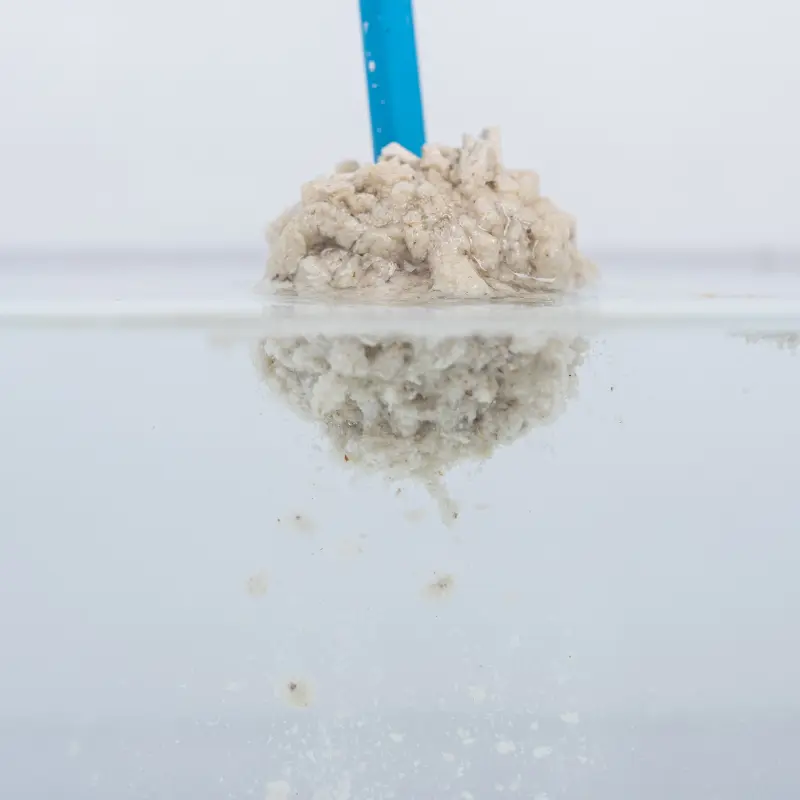
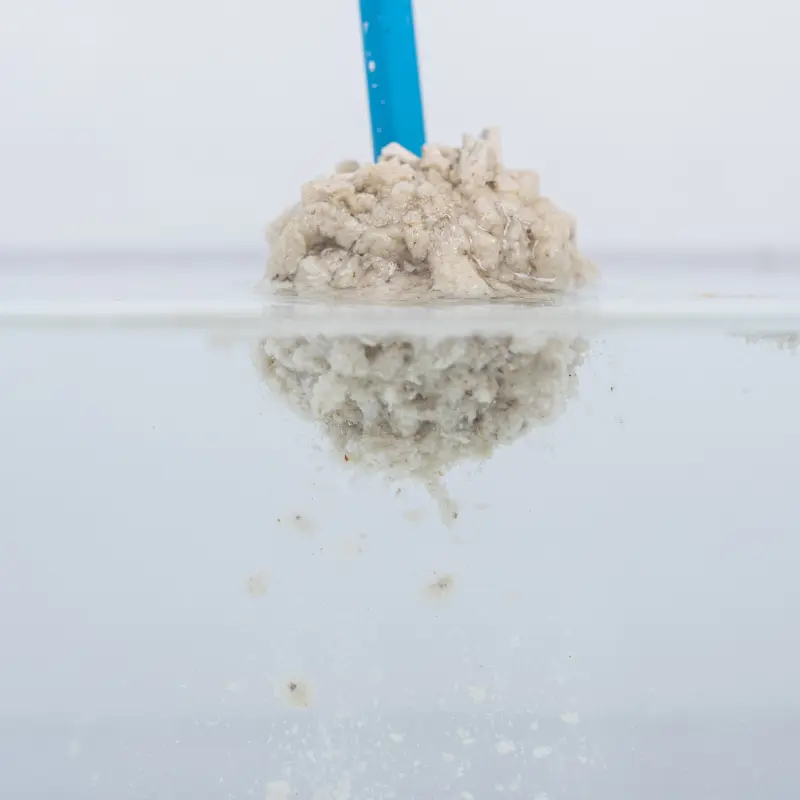
"From this picturem,we can see that the peanut shell cat litter can be dissolved into water very quickly, so it is also a flushable cat litter and it can be flushed into your toilet"
How to use peanut shell cat litter?
Transitioning your cat to peanut shell cat litter or any new type of litter should be done gradually to help your cat adjust comfortably. Here's a step-by-step guide on how to transition your cat to peanut shell cat litter:
1. Gather Supplies:
You'll need the following supplies:Peanut shell cat litter.
Your cat's current litter (if different).
A clean litter box.
2. Start Mixing:
Begin by mixing a small amount (about 25%) of the new peanut shell cat litter with your cat's old litter (if you are transitioning from a different type of litter). Use a separate container to blend them together.
3. Observe Your Cat:
Allow your cat to use the litter box with the mixed litter. Pay attention to their behavior and whether they seem comfortable with the change.
4. Gradually Increase Peanut Shell Litter:
Over the next several days (or longer, depending on your cat's comfort level), gradually increase the proportion of the new peanut shell cat litter while reducing the old litter. For example:Day 1-2: 25% peanut shell litter, 75% old litter
Day 3-4: 50% peanut shell litter, 50% old litter
Day 5-6: 75% peanut shell litter, 25% old litter
Day 7 and beyond: 100% peanut shell litter
5. Monitor Your Cat:
Keep a close eye on your cat throughout the transition process. Look for signs of discomfort, refusal to use the litter box, or changes in litter box behavior.
6. Complete the Transition:
Once your cat is comfortably using the new peanut shell cat litter, you can switch to using it exclusively. Remove any remaining old litter from the box.
7. Maintain Regular Cleaning:
Continue to maintain your cat's litter box hygiene by scooping waste daily and changing the entire litter box periodically, as recommended by the litter manufacturer.
8. Watch for Allergic Reactions:
If you notice any allergic reactions or unusual behavior during the transition, consult your veterinarian for guidance.
9. Patience and Positive Reinforcement:
Be patient with your cat during the transition process. Some cats may adjust quickly, while others may take more time. Positive reinforcement, such as praise and treats when your cat uses the new litter, can help make the transition smoother.
By following these steps, you can provide your cat with a clean, comfortable, and eco-friendly litter box experience using peanut shell cat litter. This natural and sustainable option is an excellent choice for both your pet and the environment.
Our innovative cat litter solution, made from natural and sustainable peanut shells and incorporating recycled materials, has taken Europe by storm. Cat owners across the continent are embracing this eco-conscious choice for its outstanding performance, eco-friendliness, and commitment to a cleaner, greener world. Join the movement and provide your feline friend with the best in comfort and environmental responsibility. Make the switch to eco-friendly peanut shell cat litter and be a part of the solution in Europe.
What Are the Limitations and Risks of Peanut Shell Cat Litter?
A product-line decision should consider potential drawbacks as carefully as possible benefits.
1. Limited independent market evidence
A product page may describe peanut shell litter as having good sales in Europe. Without sales volume, retailer coverage, country-level data, or independent market research, that claim should not be treated as proof of widespread demand.
For a new product line, begin with small-scale validation where commercially possible. Seek feedback from distributors, pet retailers, e-commerce customers, and potential repeat buyers.
2. Performance may vary by formulation
The same raw material can produce different results depending on particle preparation, moisture, binders, and processing conditions.
Weak clumps, excessive fines, poor absorption, or inconsistent pellet dimensions can reduce customer satisfaction, even if the ingredient source is attractive.
Before purchasing a container, evaluate representative samples and agree on a written product specification.
3. Environmental claims require evidence
Terms such as “eco-friendly,” “sustainable,” “biodegradable,” and “low environmental impact” may imply benefits that extend beyond the simple use of peanut shells.
To substantiate such claims, buyers should consider the actual proportion of recovered material, processing requirements, packaging, transport, product consumption, and disposal conditions.
The European Commission's consumer-protection guidance is especially relevant for businesses marketing environmental benefits to European consumers. Directive (EU) 2024/825 became applicable from 27 September 2026, strengthening protections against misleading environmental claims. The separate proposed Green Claims Directive remains a distinct policy initiative, so businesses should assess the rules that apply to their specific claims and national market.
For a product marketed with recovered peanut shells, a precise statement describing the material source may be more defensible than a broad claim that the whole product is “completely green.”
4. Peanut-derived raw material requires supply-chain checks
Because the formulation uses peanut shells, manufacturers should maintain appropriate controls over raw material cleanliness, storage, foreign materials, and processing consistency.
For B2B buyers, it is also sensible to ask whether the supplier has assessed residual peanut protein or other relevant contamination risks, particularly if the brand intends to make broad safety claims or target highly sensitive households.
This does not mean peanut shell cat litter is inherently unsafe. It means that a by-product-based ingredient should be covered by a documented material specification and suitable risk assessment.
5. Flushability should not be assumed
The manufacturer's listing describes the product as flushable. However, visible breakdown in water does not prove that a cat litter is suitable for household plumbing, sewer networks, septic systems, or every European wastewater system.
Before using a flushability claim, request the supporting test method and documentation, and determine whether the claim is appropriate in the target country.
For consumers, the safest approach is to follow the exact product instructions and local disposal requirements. If flushability has not been adequately established for the intended setting, do not recommend flushing the litter.
Peanut Shell Cat Litter vs. Corn, Tofu, Clay, and Silica Litter
Peanut shell litter should be evaluated against other categories according to your brand position and customer needs.
| Factor | Peanut shell litter | Corn litter | Tofu litter | Clumping clay litter | Silica crystal litter |
|---|---|---|---|---|---|
| Primary material | Processed peanut shells plus other ingredients | Corn-derived materials | Plant-derived ingredients, often soybean-based | Mineral clay, often bentonite | Silica gel |
| Main product story | Use of recovered agricultural material | Plant-derived material | Plant-derived material | Established mineral-litter category | Moisture-absorbing crystal format |
| Clumping | Depends on the formulation | Depends on the formulation | Depends on the formulation | Many products form clumps | Commonly non-clumping |
| Texture options | Depends on pellet design | Granules or other formats | Often pellet-based | Usually granular | Crystal or granular |
| Dust | Must be measured for the specific product | Must be measured for the specific product | Must be measured for the specific product | Must be measured for the specific product | Must be measured for the specific product |
| Environmental assessment | Requires raw material, production, transport, and disposal evidence | Requires full product-level assessment | Requires full product-level assessment | Includes mineral sourcing and disposal | Includes material processing and disposal |
| Best buying question | Does the product's performance justify its price and material story? | Does the formula offer the required clumping and absorption? | Does the pellet texture suit the target customer? | Does it deliver dependable performance and value? | Does its moisture handling fit the household's cleaning routine? |
The important point is that no material category is automatically superior in every metric. Compare finished products using consistent tests and evaluate whether the proposed material fits the brand's intended customers.
How to Test Peanut Shell Cat Litter Before Launching a Product Line
For importers and private-label brands, sample evaluation helps reduce the risk of launching a product that sounds attractive but performs inconsistently.
The following framework is a suggested product-development procedure, not a claim that a particular batch has passed these tests.
Step 1: Verify the raw materials and specification
Request the ingredient declaration, technical data sheet, batch number, and relevant test documents.
For peanut shell material, confirm the source, processing controls, moisture range, particle consistency, and any relevant foreign-material or contamination controls.
Step 2: Test absorption under consistent conditions
Use an agreed procedure with a fixed sample weight, defined test liquid, measured liquid volume, controlled exposure time, and a documented calculation method.
Run multiple trials and compare the results against the agreed specification.
Do not compare a supplier's absorption figure with another supplier's figure unless their test methods and conditions are sufficiently comparable.
Step 3: Evaluate clump integrity
Apply the defined test liquid under the agreed conditions and allow the clump to form for a specified period.
Lift the clump with a consistent scoop or test device. Record whether it remains intact, how much material breaks away, and whether wet residue remains on the tray.
If clump strength is a key selling point, agree on an objective acceptance method before production.
Step 4: Measure dust and fines
Screen or measure the product using a defined method and record the proportion of fines.
The test should specify the equipment, sample quantity, handling procedure, and calculation method. A brief visual inspection alone is not enough to support quantitative claims such as “99% dust-free.”
Step 5: Evaluate odor performance
Odor perception depends on the test conditions, waste type, moisture, ventilation, and cleaning frequency.
For commercial product comparisons, use consistent conditions and document the method. If odor-control claims are important, consider a qualified laboratory protocol appropriate to the claim.
For household trials, regular scooping and product instructions should be maintained. Do not leave waste in the box longer than recommended merely to test the product's limits.
Step 6: Check storage stability and packaging
Store representative samples under defined conditions appropriate to the intended distribution chain. Inspect for changes in smell, appearance, moisture, pellet integrity, or packaging condition.
Accelerated storage tests may support product development, but the relationship between accelerated conditions and real shelf life needs to be established rather than assumed.
Step 7: Approve the final product against written criteria
The approval process should include a specification sheet and clear acceptance limits for relevant indicators.
For a private-label project, the approved sample should be traceable to the agreed formula. Any material or process changes that could affect performance should be reviewed before repeat production.
How to Decide Whether Peanut Shell Cat Litter Fits Your Product Line
Peanut shell litter is not automatically the right choice for every pet brand. Use your existing sales channels, customer profile, price positioning, and product-development capacity to decide whether it deserves a place in the range.
| Your business objective | Potential fit | What to validate first |
|---|---|---|
| Expand into plant-based litter | Potentially suitable | Customer demand, clumping performance, and price |
| Differentiate through agricultural by-product use | Potentially attractive | Traceability and evidence for the recovered-material claim |
| Launch a premium eco-positioned product | Depends on evidence and performance | Product-level environmental substantiation, testing, and packaging |
| Compete mainly on the lowest retail price | May be challenging | Landed cost, shipping efficiency, and target gross margin |
| Supply supermarkets or large retail chains | Possible with additional controls | Technical documentation, packaging requirements, supply consistency, and compliance |
| Launch an online-only niche brand | Worth testing through samples and pilot orders | Customer acceptance, reviews, repeat purchase, and fulfillment cost |
| Add a private-label product without changing existing manufacturing | Depends on the supplier's capabilities | Formula flexibility, MOQ, lead time, and quality controls |
A practical launch decision framework
Before launching, answer four questions.
1. Is there a clearly defined customer?
Decide whether the product is aimed at environmentally conscious consumers, premium pet retailers, plant-based litter buyers, or an existing customer base that wants another material option.
2. Does the product solve a practical problem?
Potential differentiation is not enough. The product should meet expectations for clumping, odor, dust, handling, and cleaning.
3. Can the economics work?
Build a landed-cost model that includes product price, freight, insurance where applicable, customs and tax treatment, handling, warehousing, retailer margin, and expected promotional costs.
4. Can the claims be supported?
Make sure each environmental or performance statement has appropriate evidence. If the evidence is missing, revise the claim or conduct the required test before launching.
If one or more answers is unclear, consider completing product and market validation before committing to a large order.
OEM and Private-Label Peanut Shell Cat Litter for Europe
Gelin Town Pet lists peanut shell cat litter with OEM services and customized packaging.
Its published standard options include 6L/2.5kg, 7L/2.8kg, and 10L/4.5kg. The listed minimum order quantity is one 20-foot container, with T/T payment terms. These conditions should be confirmed directly before placing an order.
A typical OEM project involves the following stages:
Define the target product. Establish the intended customer, package size, granule format, fragrance requirements, and price range.
Confirm the formulation. Review the ingredient declaration and agree on any requested formulation changes.
Evaluate samples. Test absorption, clumping, dust, odor, tracking, storage stability, and packaging.
Set quality criteria. Document the final specification, test methods, acceptance limits, and inspection process.
Approve packaging and claims. Confirm artwork, language, barcode, material information, directions, storage, and disposal wording.
Confirm order and delivery terms. Agree on production scheduling, payment, loading, shipping documents, and quality responsibilities.
For European businesses, packaging and environmental claims deserve early attention. The EU Packaging and Packaging Waste Regulation entered into force on 11 February 2025 and began applying from 12 August 2026, with specific provisions and transition arrangements. Confirm which requirements apply to the particular packaging, operator, and market before finalizing an order.
A well-prepared product specification helps the importer and manufacturer evaluate performance and maintain consistency across repeat orders.
Frequently Asked Questions
Is peanut shell cat litter popular in Europe?
Peanut shell litter is offered as an OEM product by Gelin Town Pet, but an individual supplier's product page is not sufficient evidence of broad European market popularity. Buyers should assess distributor interest, retail demand, repeat orders, competing products, and consumer feedback in their intended country.
What is peanut shell cat litter made of?
Gelin Town Pet lists peanut shells, pea fibre, corn starch, and guar gum as the main ingredients. Buyers who need more detailed ingredient information should request the current product specification from the manufacturer.
Does peanut shell cat litter really use recycled materials?
The product is marketed as using recovered or recycled peanut shells, an agricultural by-product. The extent of recycled material in the complete formula should be confirmed through the manufacturer's documentation. Do not assume that every ingredient or the packaging is recycled.
Is peanut shell cat litter biodegradable?
The manufacturer describes the product as biodegradable, but the public listing does not provide a detailed testing method or results. Request evidence covering the finished product and the conditions under which biodegradation was evaluated before using the claim in European marketing.
Can peanut shell cat litter be flushed down the toilet?
Do not assume that it can. The manufacturer's listing claims flushability, but suitability for plumbing and wastewater systems depends on testing and local requirements. Follow the product instructions and local guidance; without adequate support, do not recommend flushing.
What is the absorption rate of this peanut shell cat litter?
The manufacturer's listing gives an absorption rate of at least 350%. The public page does not specify the complete test procedure, so buyers should confirm the measurement method, sample conditions, and supporting data before comparing it with other formulas.
What package sizes are available?
The published options are 6L/2.5kg, 7L/2.8kg, and 10L/4.5kg, with customized packaging available by arrangement. Confirm the final bag dimensions, material, carton configuration, and loading plan for the intended order.
Can European pet brands order peanut shell cat litter under their own labels?
Gelin Town Pet lists OEM and customized packaging services. The published minimum order quantity is one 20-foot container. Buyers should confirm current order terms, formula options, lead time, quality documentation, and shipping arrangements before committing.
Final Recommendation: Validate the Market, the Formula, and the Claims
Peanut shell cat litter offers a potentially useful way to turn an agricultural by-product into a plant-based pet product. For European brands, it may provide a distinctive option alongside corn, tofu, and other litter types.
However, the decision to launch should be based on evidence rather than the assumption that an eco-positioned product will automatically sell well. The product needs to perform reliably, meet the target customer's expectations, and deliver acceptable economics.
Before adding it to your product line, validate three things: customer demand in the intended country, finished-product performance under a defined testing procedure, and the evidence needed to support environmental and disposal claims.
For B2B buyers, a representative sample, a complete technical specification, documented quality controls, and a realistic landed-cost calculation provide a stronger basis for a launch decision than an attractive ingredient story alone.
If the product meets these requirements and fits your brand's positioning, peanut shell cat litter may be worth developing as a differentiated private-label product for selected European channels.
References
- FEDIAF — European Pet Population and Market Statistics
European Commission — Sustainable Consumption and Directive (EU) 2024/825
https://commission.europa.eu/topics/consumers/consumer-rights-and-complaints/sustainable-consumption_enEUR-Lex — Directive (EU) 2024/825
https://eur-lex.europa.eu/legal-content/EN/TXT/?uri=CELEX:32024L0825European Commission — Green Claims
https://environment.ec.europa.eu/topics/circular-economy-topics/green-claims_enEuropean Commission — Packaging and Packaging Waste Regulation Guidance
https://eur-lex.europa.eu/legal-content/EN/TXT/?uri=CELEX:52026XC03084
844.webp)