180.webp)
743.webp)
635.webp)
636.webp)
785.webp)
893.webp)
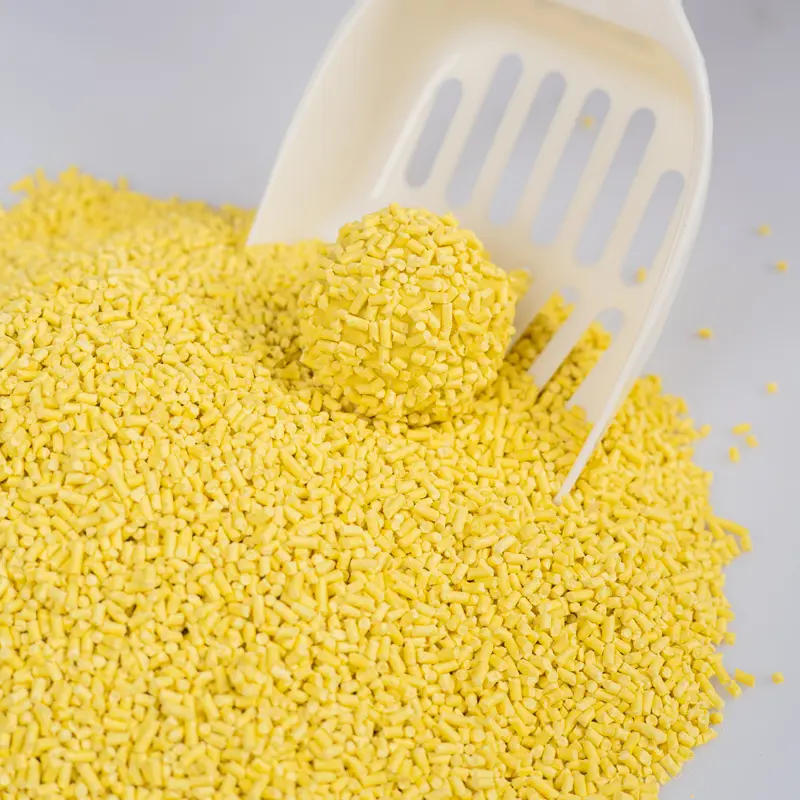
Highly absorbent clumping fine-particle corn cat litter is a product option for pet owners who want convenient litter-box cleaning, effective moisture management, and a plant-based alternative to conventional mineral litter. For Australian pet retailers, importers, wholesalers, and private label brands, it may also provide an opportunity to expand their natural and plant-based cat litter ranges.
However, high absorption, strong clumping, low dust, and odor control are separate performance characteristics. A product should demonstrate these benefits through appropriate testing rather than relying on the word “natural” or “highly absorbent” on its packaging.
In this guide, we explain how fine-particle corn cat litter works, which specifications matter, how to evaluate its performance, and how B2B buyers can develop a product for the Australian market.
Why Consider Fine-Particle Corn Cat Litter for Australia?
Australia offers a substantial customer base for cat-care products. Animal Medicines Australia's 2025 national survey estimated approximately 5.83 million pet cats and found that around 33.6% of Australian households owned at least one cat.
These figures establish the scale of the cat-owning population, but they do not prove that fine-particle corn cat litter has the highest market share. Retailers should validate demand for this particular product category through competitor research, customer feedback, sales data, and product trials.
Source: Animal Medicines Australia, Pets in Australia: A National Survey of Pets and People 2025.
For brands evaluating this product, the main commercial opportunity is to combine several practical benefits:
Moisture absorption: Reduce the amount of free liquid left in the litter when used as directed.
Clumping performance: Form cohesive clumps that are easier to remove.
Fine-particle texture: Offer a granular texture that may appeal to cats accustomed to finer litter.
Odor management: Help manage everyday litter-box odors through an appropriate formulation and regular cleaning.
Plant-derived positioning: Appeal to shoppers interested in corn-based or other plant-derived materials, provided the ingredient and environmental claims are accurate.
Private label flexibility: Develop packaging and specifications for different retail channels.
The strongest product proposition is not simply “corn cat litter.” It is a clearly specified product whose performance matches the expectations of its intended buyers.
What Is Highly Absorbent Clumping Fine-Particle Corn Cat Litter?
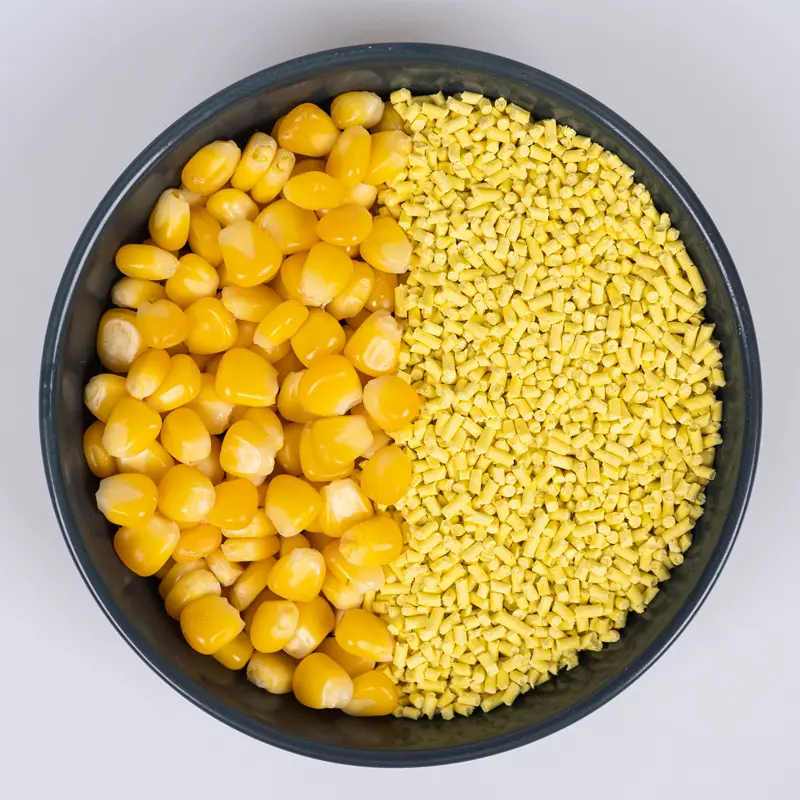
Corn cat litter is generally made from corn-derived material processed into particles or granules. Depending on the formula, manufacturers may use additional binders or functional ingredients to influence absorption, clumping, texture, and odor management.
Fine-particle corn cat litter uses a relatively small granular format rather than relying exclusively on large cylindrical pellets. The actual texture depends on the particle-size distribution, particle shape, processing method, and final formulation.
Three product characteristics should be assessed separately.
1. High absorption capacity
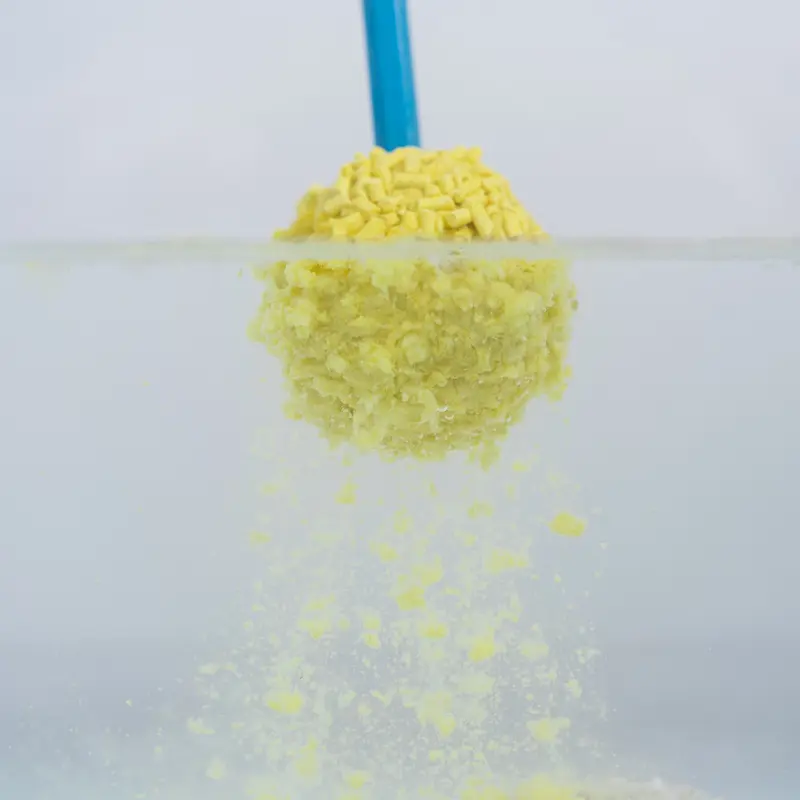
Absorption describes how much liquid a material takes up under defined test conditions. A product with high absorption may help manage moisture, but absorption alone does not prove that it forms strong clumps or controls odor effectively.
For a meaningful comparison, manufacturers should report the test method, sample weight, liquid type, exposure time, and calculation method.
2. Clumping strength
Clumping describes how wet litter binds together after absorbing liquid. Strong clumps can make scooping easier and may reduce the amount of wet material left in the tray.
Performance depends on formulation, particle size, liquid exposure, and how long the material is allowed to set before scooping. A product should be tested under repeatable conditions before being marketed as a strong-clumping litter.
3. Fine-particle design
Fine particles can provide a granular texture that some cats may prefer. However, smaller particles do not automatically mean better absorption, less dust, or stronger clumps.
The ideal particle specification should balance cat acceptance, handling, dust generation, tracking, and the intended use of the product.
Key Product Specifications for B2B Buyers
For importers and private label brands, a technical specification sheet is more useful than a general claim such as “super absorbent corn litter.”
The following table is a product-development framework. It does not represent tested results for a particular product. Actual values should be agreed with the manufacturer and confirmed through testing.
| Specification | What to request | Why it matters |
|---|---|---|
| Main material | Corn-derived ingredients and any additives | Ingredient transparency |
| Particle size | Target range in millimeters | Texture and consistency |
| Particle-size distribution | Percentage within defined size bands | Batch uniformity |
| Moisture content | Measured percentage and test method | Storage and product stability |
| Absorption capacity | Measured result under a documented method | Moisture-management performance |
| Clumping strength | Defined test method and acceptance criteria | Scooping and waste removal |
| Dust level | Test method and measured result | Handling experience |
| Bulk density | Measured value, such as g/L | Packaging and freight calculations |
| Odor management | Test conditions and evaluation method | Support for odor-control claims |
| Fragrance | Unscented or specified fragrance options | Customer preferences |
| Packaging | Bag weight, material, seal, and carton dimensions | Retail readiness and logistics |
| Shelf life | Validated period and storage conditions | Inventory planning |
How fine should the particles be?
There is no single particle size that is best for every cat litter product. Buyers should define the target range based on the intended texture and measured performance.
For example, during product development, a buyer could compare two or three particle-size grades rather than immediately selecting one. The samples should be evaluated using the same method and acceptance criteria.
Record the proportion of fine particles, the presence of oversized granules, visible dust, and any change in particle condition after handling or transport. This approach gives the buyer a more reliable basis for choosing a specification.
How to Measure Absorption and Clumping Performance
For manufacturers and product developers, absorption and clumping should be treated as measurable product characteristics.
Absorption test
A controlled test can compare how much liquid different samples absorb under the same conditions.
A practical procedure is to:
Weigh a defined quantity of litter.
Use a consistent liquid type and measured volume.
Apply the liquid using the same procedure for each sample.
Record the observation period and visible free liquid.
Measure the result using the chosen test method.
Repeat the test to assess variation.
A common way to express absorption capacity is the mass of liquid absorbed per unit mass of dry litter. The precise calculation and acceptance criteria should be stated in the technical specification.
Do not publish an absorption claim such as “absorbs 300% of its weight” unless the exact product has achieved that result under a documented method.
Clumping test
Clumping should be assessed separately from absorption.
A practical evaluation can use the same litter depth, liquid volume, waiting period, and scooping procedure across all samples. Record whether the clump remains intact, whether it breaks during removal, and how much loose material remains.
For B2B purchasing, it is useful to establish minimum acceptance criteria before testing. This makes it easier to compare suppliers and decide whether a sample is ready for approval.
Why both tests matter
A formula may absorb liquid but form weak clumps. Another may form cohesive clumps but absorb more slowly. Buyers should evaluate both characteristics instead of assuming that a high absorption result guarantees convenient cleaning.
Odor Control: What Should Buyers Expect?
Odor management is one of the most important considerations when choosing cat litter, but it depends on more than the base material.
Relevant factors include:
The formula and any odor-control additives.
The amount of litter in the tray.
The number of cats using the box.
Ventilation and room conditions.
The frequency of scooping and litter replacement.
The time between liquid exposure and cleaning.
Corn-derived material does not automatically eliminate odor. Claims such as “24-hour odor control” or “eliminates all unpleasant smells” should only be used when supported by appropriate product-specific evidence.
For a retail product, a realistic benefit statement may be more credible when it explains the intended use and the importance of regular cleaning.
For example, if testing supports the claim, a manufacturer might describe the product as designed to help manage everyday litter-box odors when used according to the instructions. This is more defensible than promising complete odor elimination in every household.
Fine-Particle Corn Cat Litter Compared with Other Materials
Australian buyers can compare corn litter with tofu, bentonite clay, and other plant-based formulations. Performance varies between individual products, so the table below provides general material-level considerations rather than a ranking of all products.
| Feature | Fine-particle corn litter | Tofu cat litter | Bentonite clay litter |
|---|---|---|---|
| Main material | Corn-derived ingredients | Often soybean residue or other plant fibers | Mineral clay |
| Typical format | Fine granules or particles | Often pellets, but formats vary | Granules |
| Absorption | Formula-dependent | Formula-dependent | Formula-dependent |
| Clumping | Depends on formulation | Depends on formulation | Many products are designed to clump |
| Dust | Must be tested | Must be tested | Varies by product |
| Texture | Can resemble granular litter | Often more pellet-like | Usually granular |
| Plant-based positioning | Possible, subject to ingredients | Possible, subject to ingredients | Generally mineral-based |
| Disposal | Follow product instructions and local rules | Follow product instructions and local rules | Follow product instructions and local rules |
| Best selection method | Test the actual product | Test the actual product | Test the actual product |
The right choice depends on the intended customer. Some shoppers prioritize texture and clumping, while others care more about weight, ingredients, price, packaging, or disposal requirements.
For retailers, offering different litter formats may help serve customers with different preferences rather than assuming one material is suitable for every household.
Practical Product Evaluation: A Step-by-Step Approach
The following is a practical testing workflow for manufacturers and buyers. It is not a report of completed testing or a claim that a particular formula has achieved a specific result.
Step 1: Inspect the sample
Check the bag seal, label, net weight, visible particle variation, and signs of moisture exposure. Record the batch or sample reference so that any results can be traced back to the product tested.
Step 2: Check particle consistency
Examine the sample for unusually large granules, excessive fines, or visible variation. If particle size is a key selling point, use a defined measurement method rather than relying on visual inspection alone.
Step 3: Evaluate pouring and dust
Pour a consistent quantity using the same method for each sample. Record visible dust and any handling issues. If dust is an important product claim, use a suitable test method and establish acceptance limits.
Step 4: Measure absorption
Apply a defined quantity of liquid and record the result under repeatable conditions. Compare products using the same sample mass, liquid, and observation period.
Step 5: Test clump removal
For clumping formulas, use a consistent waiting period before scooping. Record clump integrity, breakage, and loose material remaining in the tray.
Step 6: Assess odor management
Use a consistent evaluation plan and document the litter quantity, cleaning frequency, and test conditions. Avoid drawing conclusions from one short trial or comparing products under different conditions.
Step 7: Review packaging and transport
For wholesale orders, inspect the package seal, labeling, bag strength, carton configuration, and the condition of the litter after transport. Packaging performance can influence product quality and customer experience.
Step 8: Approve the specification
Once the sample meets the agreed criteria, document the approved formula, particle-size range, test methods, packaging, and inspection requirements before mass production.
Is Fine-Particle Corn Cat Litter Suitable for Kittens?
Kitten suitability requires additional care. Young cats may explore litter by mouthing or swallowing it, and ingesting litter can present risks. A plant-based ingredient does not automatically make a litter safe to eat.
Before marketing a fine-particle corn litter for kittens, buyers and manufacturers should consider:
The intended age range and product instructions.
The likelihood of litter ingestion.
Dust and handling characteristics.
Ingredient information and any relevant safety evaluation.
Clear warnings and usage guidance.
Whether the product has been specifically assessed for the intended use.
Monitor kittens when introducing a new litter. If a kitten repeatedly eats litter, develops digestive symptoms, or shows signs of respiratory irritation, discontinue use and seek veterinary advice.
A manufacturer should not claim that a product is “100% safe for all kittens” without appropriate evidence. Claims about safety should be specific, supported, and consistent with the actual product evaluation.
OEM and Private Label Corn Cat Litter for the Australian Market
For importers, distributors, pet retailers, and e-commerce brands, private label development offers a way to create a product with specifications and packaging suited to a defined customer group.
A manufacturer may be able to support customization in several areas, subject to its confirmed capabilities.
Formula and product development
Discuss the corn-derived material, available additives, fragrance options, and target performance. Define which features are essential and which are optional so the supplier can evaluate feasibility.
Particle-size customization
Set a measurable target for particle size and distribution. Ask the manufacturer how it checks particle consistency and manages production variation.
Packaging and branding
Possible options may include different bag weights, printed packaging, branded artwork, retail-ready labels, and customized carton configurations. Confirm available packaging materials and production requirements before approving the design.
Quality-control planning
Agree on inspection criteria for particle dimensions, moisture content, packaging integrity, and the product's key performance characteristics. Include a process for recording non-conformities and resolving quality concerns.
Typical customization workflow
Define the target market and customer requirements.
Review available formulas and product specifications.
Request samples for evaluation.
Test absorption, clumping, dust, odor management, and handling.
Confirm packaging design and labeling requirements.
Approve the final sample and written specification.
Confirm MOQ, production lead time, shipping terms, and quality-control arrangements.
For Australian buyers, it is also important to check the requirements that apply to importing, labeling, packaging, and marketing the final product. Environmental and performance claims should be verified before the product is sold.
How Australian Importers Can Assess the Total Cost
The lowest factory price does not necessarily result in the lowest landed cost.
When comparing suppliers, calculate the total cost using the actual commercial terms. Relevant components may include:
Product price per bag or kilogram.
Packaging and carton costs.
Inland transport in the country of origin.
International freight and insurance.
Applicable customs duties, taxes, and clearance charges.
Local warehousing and distribution.
Product inspection and any required testing.
A useful comparison is cost per usable kilogram rather than price per bag alone. Differences in net weight, waste, absorption performance, and cleaning frequency may influence the customer's perceived value.
Do not assume that higher absorption automatically means lower consumption. That relationship should be assessed using actual usage data from comparable trials.
For bulk procurement, request a written quotation showing the product specification, net weight, packaging configuration, MOQ, delivery terms, and quote validity period.
Frequently Asked Questions
Is highly absorbent corn cat litter popular in Australia?
Australia has a substantial cat-owning population, making cat litter a relevant category for pet retailers. However, national pet-ownership data does not establish the exact market share of highly absorbent fine-particle corn litter. Buyers should validate demand through retail research, sales data, competitor analysis, and customer trials.
Does fine-particle corn cat litter clump better than tofu litter?
Not necessarily. Clumping depends on the formulation and manufacturing process, not just the base ingredient or particle size. Compare samples using the same test method before making a performance claim.
How do I verify a high-absorption claim?
Request the test method, sample mass, liquid type, exposure time, calculation method, and measured result. Ideally, repeat the test and compare the product with alternatives under identical conditions.
Does fine-particle corn litter have less dust?
Particle size alone does not determine dust performance. Manufacturing, handling, transport, and particle breakage can affect dust levels. Use product-specific testing before describing a litter as low-dust or dust-free.
Can corn cat litter be flushed down the toilet?
Do not assume that corn-based litter is flushable. Follow the manufacturer's disposal instructions and local wastewater or plumbing guidance. Plant-derived composition does not automatically establish that a product is suitable for flushing.
Can manufacturers customize corn cat litter for private label brands?
Depending on their capabilities, manufacturers may offer options for particle size, formula, fragrance, packaging, and branding. Buyers should confirm the available options, MOQ, sample process, and quality-control requirements directly with the supplier.
What documents should an importer request?
Depending on the product and destination requirements, buyers may need a technical data sheet, ingredient information, relevant test reports, packaging specifications, labeling details, and applicable shipping or compliance documents. Confirm the exact requirements for the product and import route.
Conclusion
Highly absorbent clumping fine-particle corn cat litter can be a product-development opportunity for Australian pet retailers and private label brands seeking to expand their plant-based litter offerings. Commercial success depends on verified product performance, clear specifications, appropriate packaging, and an accurate understanding of customer demand.
For manufacturers and importers, the most reliable strategy is to test absorption and clumping separately, assess dust and odor performance under consistent conditions, and confirm the final specification before bulk production. For kitten-focused products, additional attention to age guidance and ingestion risk is essential.
A product supported by measurable performance data and transparent labeling gives retailers a stronger foundation for customer trust than broad claims alone.
References
Animal Medicines Australia. Pets in Australia: A National Survey of Pets and People 2025. https://animalmedicinesaustralia.org.au/resources/pets-in-australia-a-national-survey-of-pets-and-people-3/